The Holiday Guest Bedding Checklist: Get Your Guest Bed Ready for Thanksgiving

Beddingaholic is reader-supported. When you buy through links on our site, we may earn an affiliate commission at no extra cost to you. This checklist is a research round-up, not a hands-on test — see “How we put this checklist together” below for exactly how it was made.

Thanksgiving falls on Thursday, November 26, 2026 — and the guest bed is the part of holiday hosting that quietly decides whether your visitors sleep well or lie awake being polite about it. The bed has probably sat untouched since the last visit: sheets folded in a closet, a duvet that smells faintly of storage, one pillow that was never quite right. None of that is a disaster. All of it is fixable in a single afternoon, as long as you start with the wash and work in the right order.
That order is the whole point of this guest bedding checklist. Wash first, layer second, small touches last — because a beautifully made bed over unwashed sheets is still an unwashed bed, and a guest who is cold at 2 a.m. will not wake you to ask for a blanket. Work through the ten jobs below, in the order given, and the guest room will be ready before your guests are.
How We Put This Checklist Together
Our method, honestly: We did not hands-on test products for this article, and we don’t claim scores we didn’t earn. This is a research round-up. The wash-frequency guidance comes from the Cleveland Clinic (dermatologist Dr. Sean McGregor), the Thanksgiving date was verified against the 2026 calendar, and the care and layering advice follows Beddingaholic’s own published guides. We print no prices — they move daily in the holiday season — and no statistics we could not trace to a named source. Where a recommendation is our editorial judgement rather than a sourced fact (for example, offering two pillow firmnesses), we say so in the text.
The Guest Bedding Checklist: One Page, Ten Jobs
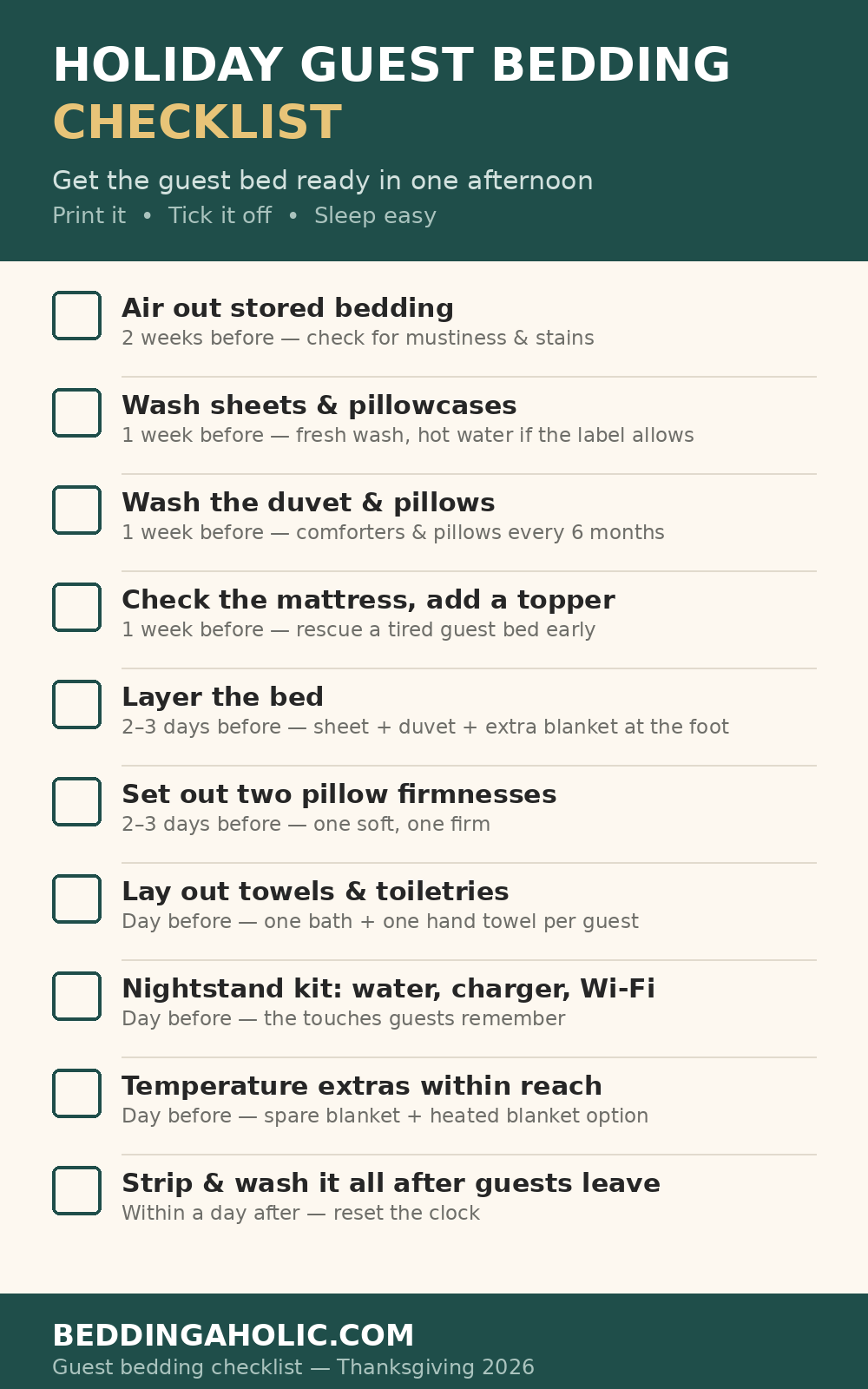
Start here. Every job below has its own section further down the page, but if you only have an afternoon, this table is the whole job. Print the graphic underneath it and tick jobs off as you go.
| # | Job | When | Why it matters |
|---|---|---|---|
| 1 | Air out the stored bedding | 2 weeks before | Stored bedding picks up a musty smell and dust; checking early leaves time to replace anything stained or damaged. |
| 2 | Wash the sheets and pillowcases | 1 week before | Cleveland Clinic guidance is to wash sheets at least weekly; stored sheets need a fresh wash whatever the calendar says. |
| 3 | Wash the duvet, pillows and protectors | 1 week before | Comforters and pillows should be washed about every six months — a guest stay is the moment to reset that clock. |
| 4 | Check the mattress; add a topper if needed | 1 week before | A topper rescues a tired guest bed, but only if you discover the problem while there is still time to fix it. |
| 5 | Layer the bed | 2–3 days before | Sheets, duvet and an extra blanket at the foot — layers your guests can adjust themselves overnight. |
| 6 | Set out two pillow firmnesses | 2–3 days before | One soft, one firm per guest — nobody should have to ask for a different pillow at midnight. |
| 7 | Lay out towels and toiletries | Day before | One bath towel and one hand towel per guest, plus the basics they forgot to pack. |
| 8 | Nightstand kit: water, charger, Wi-Fi | Day before | The small touches guests actually remember — and the ones they notice most when they are missing. |
| 9 | Temperature extras within reach | Day before | A spare blanket at the foot of the bed, plus a heated blanket option for guests who run cold. |
| 10 | Strip and wash everything after guests leave | Within a day after | Every guest stay resets the wash clock; stripping promptly keeps the next visit as easy as this one. |
Step 1: Wash the Stored Bedding First

Pull everything out of the guest-room closet two weeks before your guests arrive and look at it properly. Stored bedding collects dust, absorbs the smell of wherever it was kept, and hides stains you will only notice once the bed is made and the room is lit. Check seams, look for yellowing on pillowcases, and smell the duvet. Anything stained, torn or still smelling musty after airing goes in the wash — or gets replaced while there is still time to order a spare set.
Then wash it, a week before the visit. The Cleveland Clinic’s guidance, from dermatologist Dr. Sean McGregor, is to wash sheets at least once a week — and even washing every other week still brings real benefits, so a fresh wash before guests arrive is the minimum, not the gold standard. Use hot water if the care label allows it: the Clinic notes that hot water kills dust mites. Wash the pillowcases with the sheets, and give the duvet cover the same treatment. Dry everything completely before it goes back on the bed — damp bedding put away in a closed room is how mustiness comes back.
The bigger pieces follow the same rule on a longer cycle. Cleveland Clinic guidance puts comforters and pillows at about every six months, or as needed — and a guest stay is exactly the “as needed” moment. If your duvet lives under a cover, our guide to washing a down comforter without clumping covers the machine, soap and drying steps that keep it from going flat. And if the pillowcases come out yellowed, that is a separate job with its own method — don’t try to bleach it away in the same load; treat the stain first, then wash.
Step 2: Layer the Bed So Guests Can Adjust It

Make the bed two or three days before your guests arrive — close enough that it stays fresh, far enough ahead that you are not doing it while the turkey is in the oven. The order matters: fitted sheet first, then the flat sheet, then the duvet or comforter, then a folded throw or extra blanket at the foot of the bed. That top layer is not decoration. It is the layer a cold guest reaches for at 2 a.m. without having to wake you, and the layer a warm guest pushes aside without unmaking the bed.
This is also the moment to check the fit, not just the look. A duvet cover that is the wrong size for its insert will bunch to one side by morning and look — and feel — wrong all night. If you are unsure whether your cover matches your insert, run the measurements through our duvet cover size calculator before you make the bed; a cover one to three inches larger than the insert is the range to aim for. For the full layer order — which layer goes where in a cold house and how to keep a warm sleeper from overheating under winter bedding — our guide to how to layer bedding for winter walks through the same stack step by step.
One last check before you call the bed done: lie on it for a minute. Not a test — just a sanity check. Does the fitted sheet stay put at the corners? Does the duvet actually cover the bed edge to edge? Is there a lump in the middle where the topper (if you added one) ends? Guests will find every one of these in the first five minutes. You can find them in one.
Step 3: Offer Two Pillow Firmnesses

Pillow preference is the most personal thing about a bed, and it is the one thing guests will almost never mention. Put two pillows on the bed per guest: one soft, one firm. Our judgement, not a sourced rule — but it is the cheapest fix in this whole checklist, and it removes the one complaint guests are too polite to make. Stack them with the firmer pillow at the back, so the choice is visible the moment a guest pulls back the covers.
Wash the pillowcases with the sheets (see Step 1), and give the pillows themselves the same six-month check: Cleveland Clinic guidance is to wash pillows about every six months, and a guest stay is the right moment to do it if they are due. Fluff them after washing and drying so they hold their shape — a flat pillow reads as a neglected bed, whatever the sheets look like. If a pillow has gone lumpy, yellowed through, or lost its loft entirely, replace it rather than dressing it up with a fresh case; the case hides the look, not the feel.
If you sleep on a particular pillow yourself and love it, don’t put your own pillow on the guest bed as the “good one” and leave a flat spare as the second. Guests notice the difference between the two pillows immediately, and the message it sends is the opposite of hospitality. Two honest, freshly washed pillows of different firmnesses beat one favourite and one afterthought.
Step 4: Rescue a Tired Guest Bed With a Mattress Topper
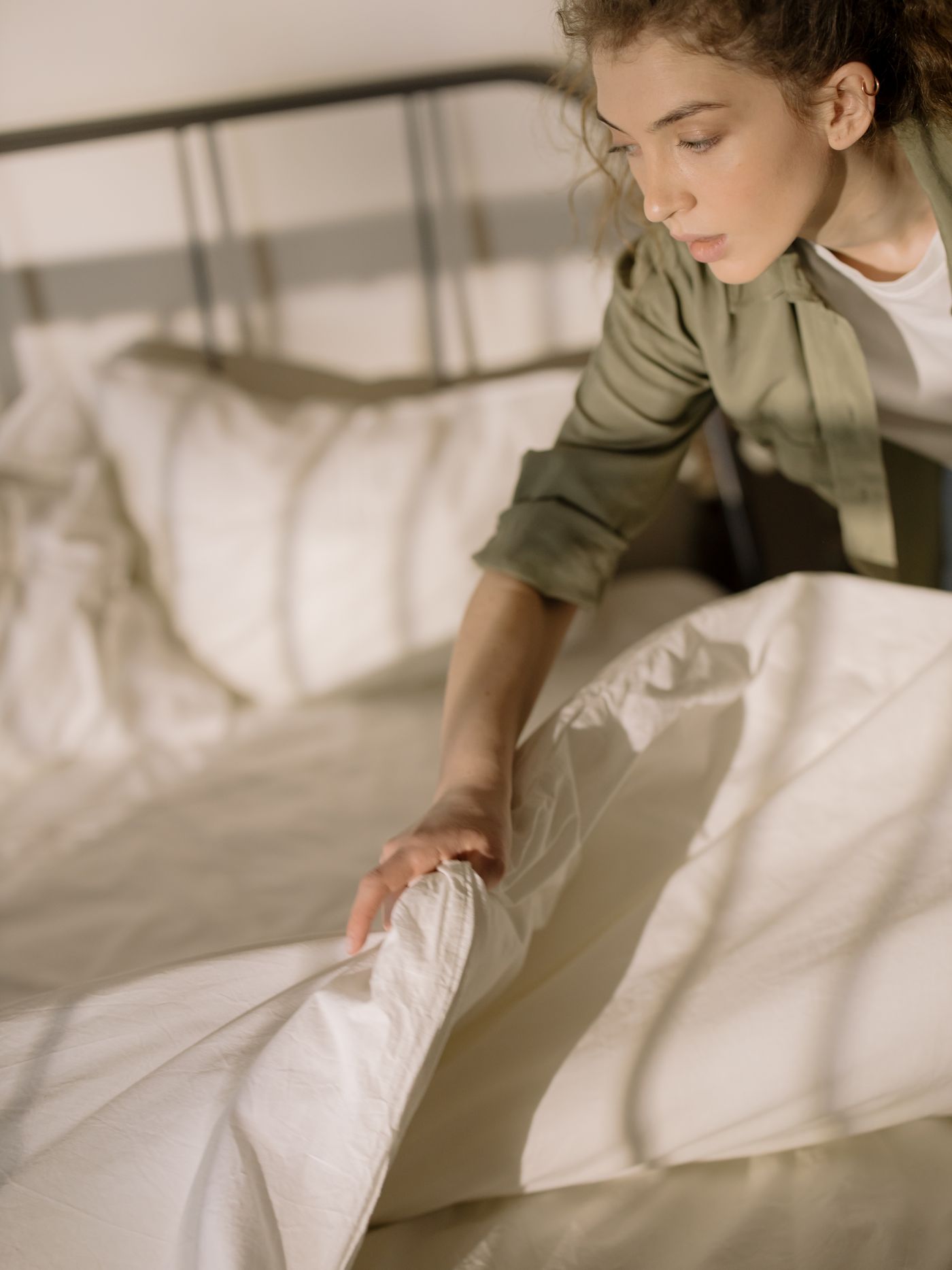
The guest mattress is usually the oldest mattress in the house, and it is the one nobody has slept on since the last visit — which means nobody knows what shape it is in. A mattress protector helps here twice over: it guards the mattress, and it gives the topper a clean surface to sit on.
If the mattress is tired but not finished, a topper is the rescue — a thick comfort layer that sits on top of the mattress and under the fitted sheet, smoothing out dips and softening a surface that has gone hard. Put it on a week before, not the night before: a topper needs a night or two to uncompress and settle, and you want to make the bed over it once, properly, rather than fighting with a half-expanded layer while guests are parking outside. If the mattress sags so deeply that a topper can’t level it, or springs poke through whatever you put over it, say so honestly to yourself now — a topper is a rescue, not a rebuild, and an air mattress in the same room is a better night’s sleep than a broken bed dressed up as a good one.
While you are there, check the bed frame too: tighten any loose bolts, and make sure the slats are all in place. A guest bed that creaks with every turn is a small thing that feels like a big thing at 3 a.m.
Step 5: Put Temperature Extras Within Reach

Your house at night is not your guests’ house at night. They don’t know which rooms run cold, they don’t know where the thermostat is, and they will not wake you to ask. So put the temperature controls where they can reach them without asking: a folded spare blanket at the foot of the bed, and — for guests who run cold — a heated blanket option, folded on top of the spare so it is obvious.
If you offer a heated blanket, offer it the safe way. Our safety-first guide to the best heated blankets covers the full checklist, but the short version is: use a blanket with independent UL or ETL certification and an automatic shut-off, use it flat and uncovered while it runs, plug it straight into a wall outlet, and preheat the bed and switch it off rather than sleeping on it all night on high. Show your guest the controller when they arrive — a two-minute explanation beats a 2 a.m. mystery. And never offer a heated blanket to a guest who can’t operate the controls themselves or move it off on their own; a spare wool blanket is the safer warm for them.
The other direction matters too. Some guests sleep hot, and a winter guest room with the heating up and a heavy duvet is a recipe for a sweaty, sleepless night. That is what the layers in Step 2 are for — a hot sleeper can push the throw and the duvet aside and sleep under the flat sheet alone. If you know a guest sleeps hot, a lighter duvet or a breathable cotton or bamboo set on their bed is worth the swap. Our comparison of luxury bamboo sheets explains why bamboo-derived fabrics sleep cooler — useful if you are buying a guest set for a hot sleeper rather than making do with what is in the closet.
Step 6: The Small Touches Guests Actually Notice

Nobody remembers a perfectly ironed flat sheet. Everybody remembers waking up thirsty with no water, or hunting for a phone charger in the dark, or standing in a hallway at midnight because they don’t know the Wi-Fi password. The small touches go on the nightstand the day before your guests arrive, and they cost almost nothing:
- A glass and water. A clean glass and a carafe or bottle of water on the nightstand, not in the bathroom down the hall.
- A phone charger. A spare cable — ideally one that fits the common phone types your guests carry — plugged in and visible, plus a free outlet that isn’t already taken by the lamp.
- The Wi-Fi password. Written on a small card on the nightstand. Guests will not ask for it twice if they can read it once.
- A lamp they can reach. A bedside lamp with a switch at the bed, not across the room. If the room has no lamp, a small one is worth buying before the visit, not after.
- Towels and the basics. One bath towel and one hand towel per guest, folded on the bed or on a chair — plus soap, a spare toothbrush and toothpaste, and a bin they can actually find.
- An empty drawer and some hangers. Guests live out of a suitcase when there is nowhere to put anything. Clear one drawer and leave a few empty hangers in the closet.
- Room to breathe. Clear the “storage” off the guest bed and out of the guest chair before they arrive. A guest room that doubles as a store cupboard tells guests they are an afterthought, however nice the sheets are.
Keep it to that list. A tray of chocolates and a scented candle are lovely if they are your style, but they are garnish — the list above is the meal. And skip anything strongly scented in the room itself: a guest with allergies or asthma will sleep worse for a plug-in air freshener than for a plain, clean room.
After Your Guests Leave: Strip It, Wash It, Reset
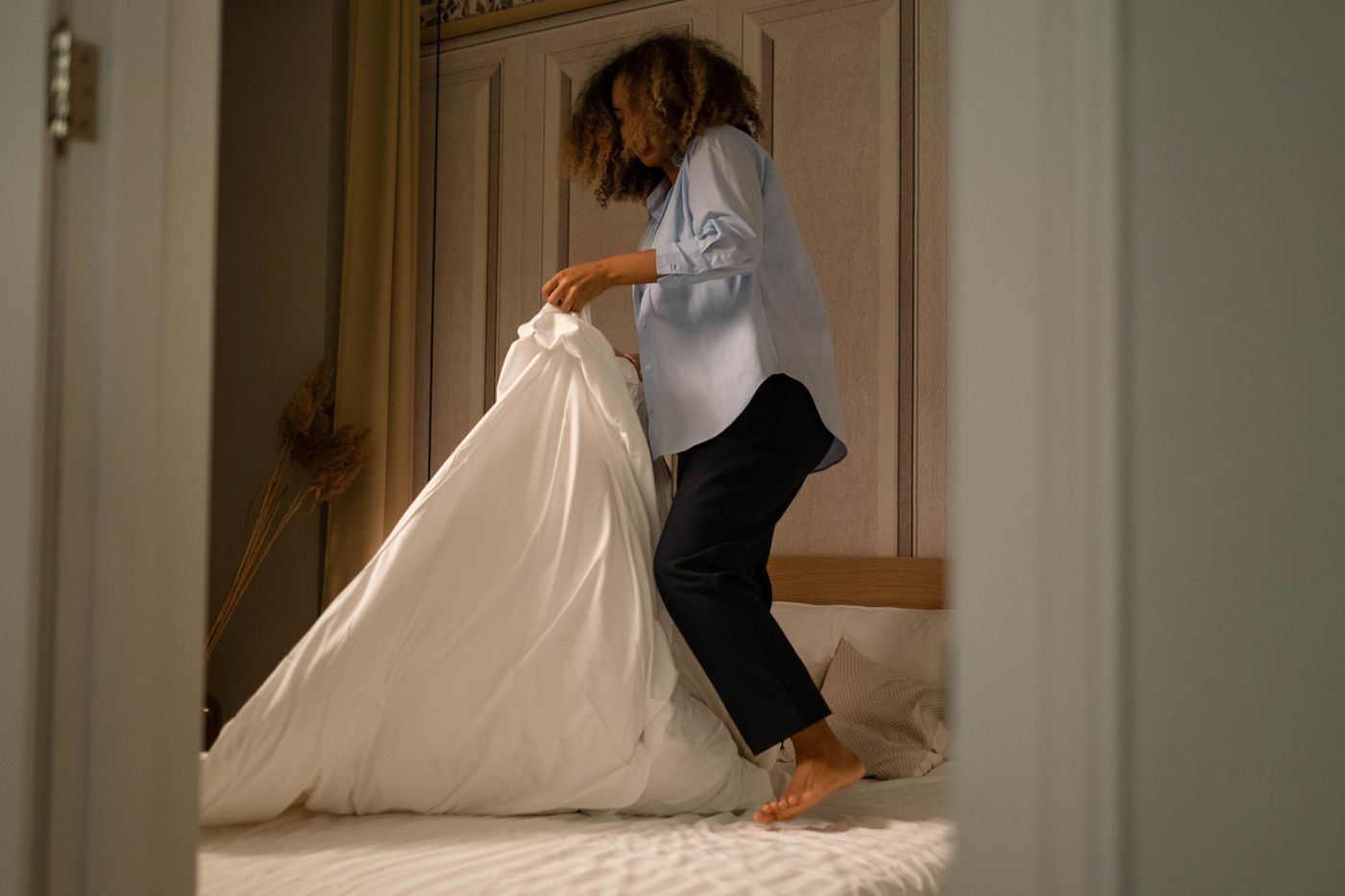
Within a day of your guests leaving, strip the bed completely: sheets, pillowcases, duvet cover, mattress protector, towels. Wash the sheets and pillowcases on the usual cycle — Cleveland Clinic guidance is weekly for sheets, and a guest stay resets that clock whatever the calendar says. Leave the bed unmade for a little while after stripping, with the mattress exposed to the air: the Clinic’s advice to let sweaty sheets dry before remaking the bed applies here too, and it is the simplest defence against the damp, musty smell that greets the next guest.
Wash the duvet cover and pillowcases with the sheets. The duvet itself and the pillows go back to their six-month cycle unless the stay was long or someone was ill — in which case, wash them now and reset the clock from this visit. If a guest was sick during the stay, wash everything they touched, including the mattress protector, and vacuum the mattress before the bed is made again; Cleveland Clinic guidance puts mattress cleaning at about every six months, and a sick guest is a good reason to do it now rather than later.
Then put the clean, dry bedding back where it lives — loosely folded, in a breathable cotton bag or on an open shelf, not sealed in plastic. That is the whole trick to making the next visit easy: the next time you open this checklist, Step 1 is already half done, because the bedding went away clean.
Frequently Asked Questions
How far ahead should I prepare the guest bed for Thanksgiving?
Start two weeks before: pull the stored bedding out, air it, and check for stains or damage. Wash everything a week before, and make the bed two to three days before your guests arrive. The bed itself is a one-afternoon job — the wash is what needs the lead time.
Should I wash bedding that has just been sitting in the closet?
Yes. Stored bedding collects dust and picks up the smell of wherever it was kept, even when it looks clean folded up. Wash the sheets and pillowcases, air the duvet, and wash the duvet cover. Cleveland Clinic guidance is to wash sheets at least once a week — stored sheets need a fresh wash whatever the calendar says.
How often should guest sheets be washed?
At least once a week while they are in use, per Cleveland Clinic guidance — and after every guest stay, however short. A guest stay resets the wash clock: strip the bed within a day of guests leaving and wash the sheets and pillowcases before they go back in the closet.
My guest bed mattress is old and uncomfortable. Will a topper fix it?
A topper rescues a tired mattress — it smooths out dips and softens a surface that has gone hard — but it is not a rebuild. Check the mattress a week before your guests arrive: lie on it, feel for sagging and springs, and add the topper then so it has time to settle. If springs poke through or the sag is deep enough that a topper can’t level it, an air mattress in the same room will give your guests a better night than a broken bed dressed up as a good one.
How many pillows should I put on a guest bed?
Two per guest: one soft, one firm. Pillow preference is personal and guests almost never mention it, so offering the choice up front is the cheapest insurance in this checklist. Put the firmer pillow at the back so the choice is visible when the covers come back.
Should I leave an extra blanket out for guests?
Yes — fold a spare blanket at the foot of the bed where a guest can reach it without waking anyone. For guests who run cold, a heated blanket is a good option too, as long as it is certified (UL or ETL), has an automatic shut-off, and is used flat, uncovered, and plugged straight into a wall outlet. Show your guest the controller when they arrive.
What should I put on the nightstand for overnight guests?
Water and a clean glass, a spare phone charger with a free outlet, the Wi-Fi password written on a small card, and a lamp with a switch they can reach from the bed. Add one bath towel and one hand towel per guest, the basic toiletries, an empty drawer and a few hangers — and clear the storage off the guest bed and chair before they arrive.
Sources
- Cleveland Clinic — “How Often Should You Wash Your Sheets?” (dermatologist Dr. Sean McGregor): wash sheets at least once a week; every-other-week washing still brings benefits; change bedding every one to two weeks; wash comforters and pillows every six months or as needed; hot water kills dust mites; leave the bed unmade a while so sheets dry; clean the mattress about every six months — health.clevelandclinic.org, checked November 15, 2026
- 2026 calendar — Thanksgiving: Thursday, November 26, 2026; Black Friday: Friday, November 27, 2026; Cyber Monday: Monday, November 30, 2026
- Beddingaholic — How to Wash a Down Comforter Without Clumping (down comforter wash cycle: once every one to two years with a duvet cover in daily use) — beddingaholic.com, live 2026-11-15
- Beddingaholic — Best Heated Blankets 2026: Safety-First Buying Guide (CPSC and ESFI safety guidance: certification, auto shut-off, flat and uncovered use, wall outlet only, preheat-then-off) — published November 14, 2026
- Beddingaholic — Duvet Cover Size Calculator (cover one to three inches larger than the insert) — beddingaholic.com, live 2026-11-15
Last updated: November 2026. We re-check wash guidance and the holiday dates as this checklist is refreshed each season.