Scandinavian Two-Duvet Method: What Size Duvets?

Beddingaholic is reader-supported. When you buy through links on our site, we may earn an affiliate commission at no extra cost to you. This guide is a research round-up, not a hands-on test — see “How this guide was put together” below. We publish no prices: they move with every sale.
Scandinavian Two-Duvet Method: What Size Duvets?

The two duvet method — also called the Scandinavian sleep method — is the simplest fix in bedding: two people share one bed, but each person sleeps under their own single duvet instead of sharing one big one. If you came here asking two duvet method what size duvets do I need, the short version is: two Twin duvets for a queen bed, two Twin XL duvets for a king bed — and Twin XL is the safer pick on a queen too if either of you is tall. The rest of this guide is the maths behind that answer, so you can buy once and buy right.
The quick answer
The method in one paragraph: one shared mattress and fitted sheet, no top sheet, and two separate single-size duvets laid side by side — one per sleeper, each in its own washable duvet cover. It comes from Sweden, Norway and Denmark, where a duvet each has long been normal, and it went viral on TikTok in October 2023 after a post by Swedish influencer Cecilia Blomdahl. Each person controls their own warmth, nobody steals the covers, and one person getting up does not drag the blanket off the other.
The size rule in one line: each duvet should be about the width of your half of the bed plus a generous overhang — two Twin duvets (about 68 × 86 in / 173 × 218 cm each) on a queen, two Twin XL duvets (about 68 × 92 in / 173 × 234 cm each) on a king or California king, and two Twin duvets on a full bed if you accept a snug fit.
What is the Scandinavian sleep method?
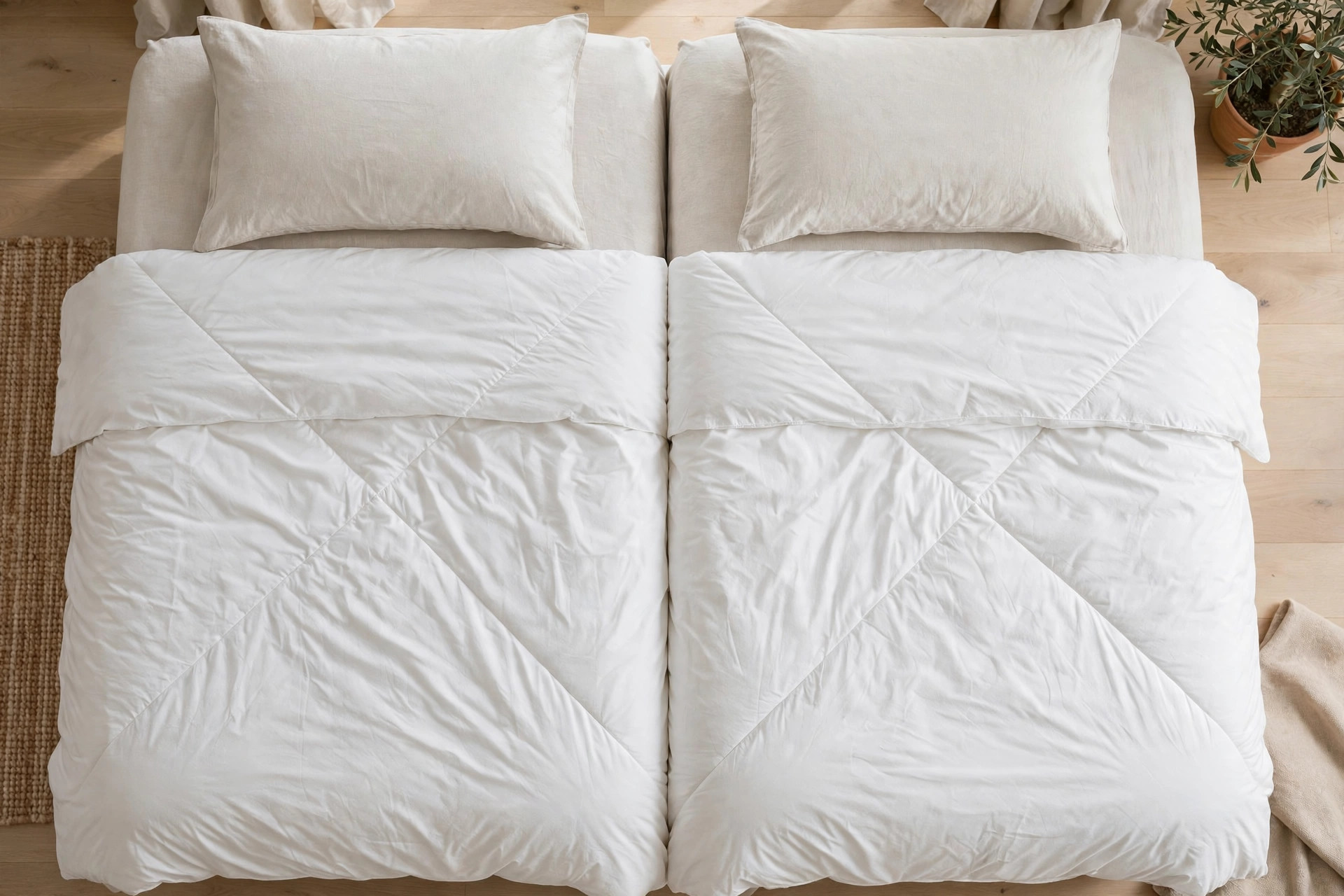
The Sleep Foundation describes it plainly: partners share a bed but ditch the top cover and sleep under their own single-size duvet or comforter instead of sharing a larger one. The usual setup is one fitted sheet over the whole mattress, two duvets on top, and your own pillows. There is typically no top sheet — the duvet cover is the layer against your skin, and it is the part you wash.
Three things to get straight:
- It is a bedding arrangement, not a sleep divorce. You still share a bed, a room and a mattress. A sleep divorce means separate beds or rooms; this is the step before that, for couples who like sharing a bed but hate sharing a cover.
- It is not a scientifically tested sleep method. No study has directly tested two duvets against one shared duvet. In a 2024 survey by the American Academy of Sleep Medicine, 10% of people said they had tried it.
- It does not fix everything. Two duvets do not stop snoring, sleep talking, or movement travelling through the mattress. If the problem is temperature or blanket-hogging, it very likely is.
It works for a mechanical reason, not a magical one: a shared duvet is one sheet of fabric between two moving bodies, so when one person rolls over, the fabric pulls on the other side. Two duvets break that connection — each moves only with its own sleeper, and each sleeper chooses their own weight.
Two-duvet size calculator

Pick your bed, the taller sleeper’s height, and how you sleep. The calculator gives you the duvet size per person, the overhangs, and a tog pairing. It uses the standard US sizes in this guide: a Twin duvet is 68 × 86 in (173 × 218 cm) and a Twin XL is 68 × 92 in (173 × 234 cm). Brands vary by about ±2 in, so check the label.
Two-Duvet Size Calculator
If the calculator above does not load (some readers and print views strip scripts), use the static table below — the same answers for every bed size.
Static fallback: the answers for every bed
| Bed (mattress) | Duvets to buy | Outer overhang each side | Middle overlap | Foot overhang |
|---|---|---|---|---|
| Full / Double 54 × 75 in (137 × 191 cm) | Two Twin 68 × 86 in (173 × 218 cm) | 20.5 in (52 cm) | 41 in (104 cm) | 11 in (28 cm) |
| Queen 60 × 80 in (152 × 203 cm) | Two Twin 68 × 86 in (173 × 218 cm) | 19 in (48 cm) | 38 in (97 cm) | 6 in (15 cm) |
| Queen 60 × 80 in (152 × 203 cm) | Two Twin XL 68 × 92 in (173 × 234 cm) | 19 in (48 cm) | 38 in (97 cm) | 12 in (30 cm) |
| King 76 × 80 in (193 × 203 cm) | Two Twin XL 68 × 92 in (173 × 234 cm) | 15 in (38 cm) | 30 in (76 cm) | 12 in (30 cm) |
| California King 72 × 84 in (183 × 213 cm) | Two Twin XL 68 × 92 in (173 × 234 cm) | 16 in (41 cm) | 32 in (81 cm) | 8 in (20 cm) |
| California King 72 × 84 in (183 × 213 cm) | Two Twin 68 × 86 in (173 × 218 cm) | 16 in (41 cm) | 32 in (81 cm) | 2 in (5 cm) — too short, avoid |
Outer overhang is how far your duvet hangs past the edge of the mattress on your side; middle overlap is how far the two duvets cross in the centre; foot overhang is how far the duvet runs past the end of the mattress. A Twin on a California king leaves only 2 in (5 cm) at the foot — that is why the calculator steers California king sleepers to Twin XL every time.
Master size table: two duvets for every bed
This is the table to screenshot: US bed sizes and their UK and EU equivalents, the duvet size each sleeper needs, and the overhang that results. Every figure comes from two inputs — standard mattress dimensions and standard duvet dimensions — and the arithmetic is shown below so you can check it against any brand’s label.
| Bed | Mattress (in / cm) | Each sleeper’s duvet | Outer overhang | Middle overlap | Foot overhang |
|---|---|---|---|---|---|
| Full / Double | 54 × 75 in 137 × 191 cm | Two Twin 68 × 86 in (173 × 218 cm) | 20.5 in (52 cm) | 41 in (104 cm) | 11 in (28 cm) |
| Queen | 60 × 80 in 152 × 203 cm | Two Twin 68 × 86 in (173 × 218 cm) | 19 in (48 cm) | 38 in (97 cm) | 6 in (15 cm) |
| Queen (tall sleeper) | 60 × 80 in 152 × 203 cm | Two Twin XL 68 × 92 in (173 × 234 cm) | 19 in (48 cm) | 38 in (97 cm) | 12 in (30 cm) |
| King | 76 × 80 in 193 × 203 cm | Two Twin XL 68 × 92 in (173 × 234 cm) | 15 in (38 cm) | 30 in (76 cm) | 12 in (30 cm) |
| California King | 72 × 84 in 183 × 213 cm | Two Twin XL 68 × 92 in (173 × 234 cm) | 16 in (41 cm) | 32 in (81 cm) | 8 in (20 cm) |
| UK Double | 135 × 190 cm 53 × 75 in | Two Single 135 × 200 cm (53 × 79 in) | 34 cm (13.4 in) | 67.5 cm (26.6 in) | 10 cm (4 in) |
| UK King | 150 × 200 cm 59 × 79 in | Two Single 135 × 200 cm (53 × 79 in) | 30 cm (11.8 in) | 60 cm (23.6 in) | 0 cm |
| EU Queen / King (160 cm) | 160 × 200 cm 63 × 79 in | Two 140 × 200 cm (55 × 79 in) | 30 cm (11.8 in) | 60 cm (23.6 in) | 0 cm |
| EU Queen / King (160 cm) | 160 × 200 cm 63 × 79 in | Two 150 × 200 cm (59 × 79 in, e.g. IKEA Single) | 35 cm (13.8 in) | 70 cm (27.6 in) | 0 cm |
How the numbers are worked out
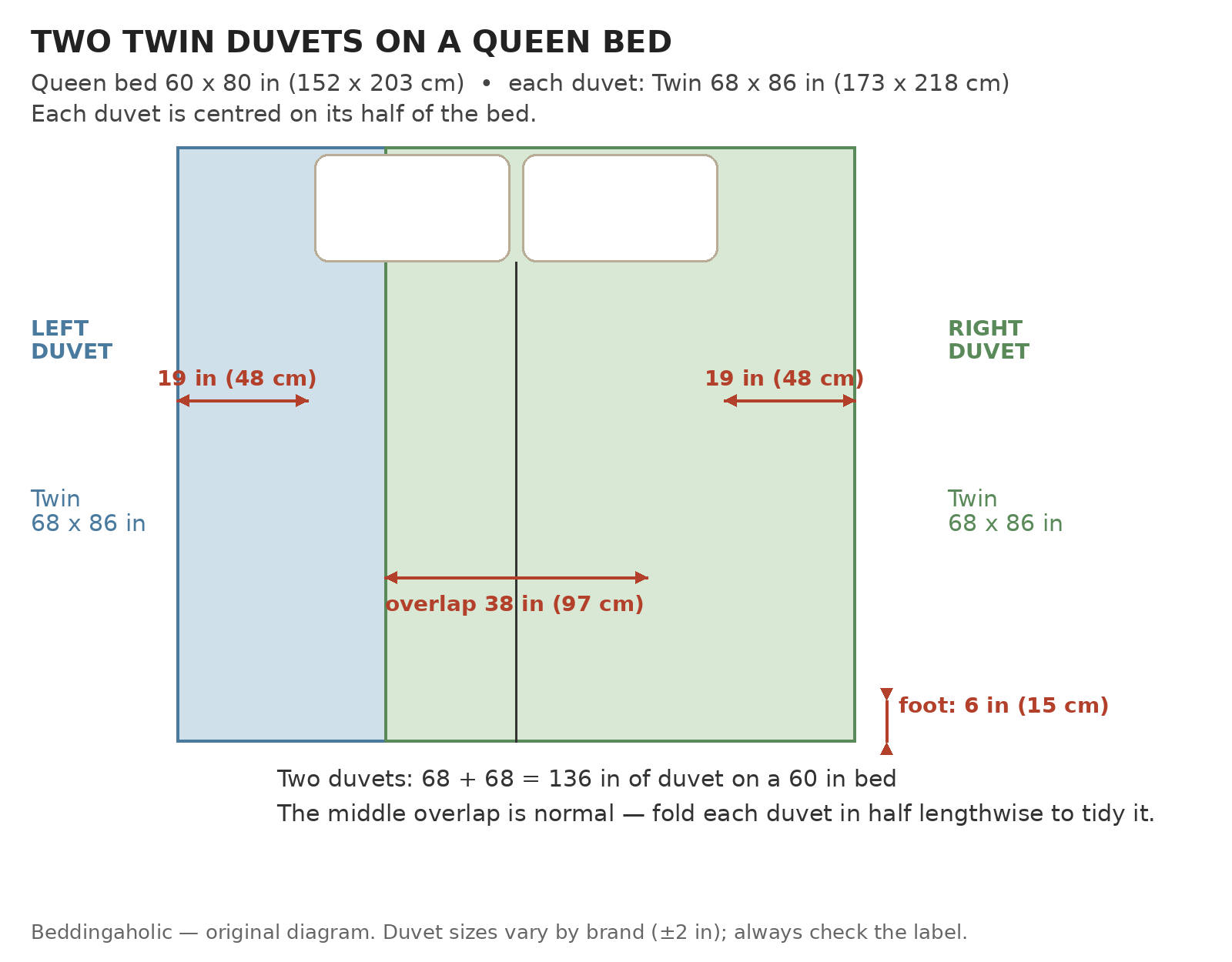
Three subtractions, with each duvet centred on its half of the bed. Outer overhang = (duvet width ÷ 2) − (bed width ÷ 4): on a queen, 34 − 15 = 19 in (48 cm). Middle overlap = duvet width − (bed width ÷ 2): on a queen, 68 − 30 = 38 in (97 cm) — always large, and supposed to be there. Foot overhang = duvet length − bed length: a Twin (86 in) on a queen or king (80 in) leaves 6 in (15 cm); a Twin XL (92 in) leaves 12 in (30 cm).
Do not buy two Full or two Queen duvets for one bed. Two Full duvets (about 86 in wide each) on a queen would overlap by 56 in in the middle and hang 28 in off each side — a doubled-up mess that defeats the point. The method works because each duvet is single-sized.
The standard US duvet sizes behind the table
The dimensions here are the standard US sizes as published by the brands, agreeing within a couple of inches: Twin 68 × 86 in (173 × 218 cm); Twin XL 68 × 90–92 in (173 × 229–234 cm) — same width, five to six inches longer, for tall sleepers and long beds; Full/Queen about 88–90 × 90–94 in and King about 104–106 × 90–94 in — the shared-duvet sizes you are replacing. One exception: Parachute’s Twin/Twin XL insert is 60 × 88 in — on a queen it gives only 15 in (38 cm) of outer overhang. Buy by the centimetres on the label, not by the size name.
UK and EU sizes: the same method, different names
In the UK and Europe the method is not a trend — it is simply how beds are made. The names change, the maths does not.
- UK: a standard Single duvet is 135 × 200 cm (53 × 79 in), a Double is 200 × 200 cm, a King is 230 × 220 cm and a Super King is 260 × 220 cm (Ideal Home and Christy agree on all four). For two duvets, buy two Singles: on a UK Double bed (135 × 190 cm) about 34 cm at the sides and 10 cm at the foot; on a UK King bed (150 × 200 cm) about 30 cm at the sides and nothing at the foot. If that bothers you, buy the 150 × 200 cm single size IKEA sells.
- EU / IKEA: IKEA’s standard sizes are 150 × 200 cm (Single), 200 × 200 cm (Double) and 240 × 220 cm (Queen/King). On a 160 × 200 cm bed, two 140 × 200 cm duvets give 30 cm at the sides and no foot overhang; two 150 × 200 cm duvets give 35 cm. For foot drape, look for 220 cm-long duvets, which add about 20 cm.
- US readers buying imported duvets: a UK Single (135 × 200 cm) is narrower and shorter than a US Twin (173 × 218 cm) — do not assume the names match. A UK Double duvet (200 × 200 cm) is far too wide for one sleeper in this method. Always convert: 1 in = 2.54 cm.
Warmth pairing: tog ratings per sleeper and season
A tog rating measures how well a duvet holds heat — thermal insulation, in plain words. The higher the tog, the warmer the duvet. The scale is a UK and EU convention; the seasonal bands below are the consensus across the published tog guides (Primark, Tom’s Guide and CloudPillo all publish the same bands).
| Tog | Season / room | Who it suits | US shop language |
|---|---|---|---|
| 1–4.5 | Summer; warm bedrooms | Hot sleepers | Lightweight |
| 7.5 | Spring / autumn; warm homes | Hot sleepers, shoulder season | Lightweight to All-season |
| 9–10.5 | All-season; average rooms | Most adults | All-season / Midweight |
| 12–13.5 | Winter; cool bedrooms | Cold sleepers | Ultra-warm / Heavyweight |
| 15 | Deep winter; very cold rooms | Very cold sleepers | Ultra-warm / Heavyweight |
10.5 tog is the all-round pick for a heated home, and 13.5 tog is the usual winter answer. But the all-round pick is exactly what the two-duvet method lets you escape. The useful pairings are per sleeper, not per bed:
- One hot, one cold: the hot sleeper takes 4.5 tog in summer and 7.5 tog in winter; the cold sleeper takes 10.5 tog in summer and 13.5 tog in winter. Same bed, two different duvets, nobody compromising. This is the pairing the method was made for.
- Both cold: both on 10.5 tog most of the year, both up to 13.5 tog in winter. Add a light blanket on the coldest nights rather than jumping to 15 tog.
- Both hot: both on 4.5 tog in summer and 7.5–10.5 tog in winter — and check the fill: a breathable fill (cotton, wool, bamboo) matters more than the tog number when you sleep hot.
- All-season duvets: typically a 4.5 tog layer and a 9 tog layer that clip together for 13.5 tog in winter. With two sleepers you would need two sets; two fixed-tog duvets are usually cheaper.
A note for US readers: American brands rarely print tog numbers. Brooklinen sells Lightweight, All-season and Ultra-warm; Parachute sells Lightweight, Midweight and Heavyweight, and publishes fill weights instead — 20 oz, 25 oz and 35 oz for its Twin/Twin XL insert. The translation: Lightweight ≈ 4.5 tog, All-season / Midweight ≈ 10.5 tog, Ultra-warm / Heavyweight ≈ 13.5–15 tog.
If one of you runs hot and the other runs cold, a heated layer can help the cold sleeper without cooking the hot one — our heated blanket buying guide covers safety-first picks, and our heated mattress pad vs heated blanket comparison works out which suits a shared bed. The duvet pairing above is the first fix; add heat only if it is not enough.
How to set it up so the bed still looks like a bed
The most common complaint about two duvets has nothing to do with sleep — it is that the bed looks like a hostel in the morning. It does not have to. The setup takes two minutes:
- Fitted sheet on, top sheet off. One fitted sheet covers the whole mattress. Skip the top sheet — the duvet cover is the washable layer against your skin. If you cannot give up a top sheet, use two twin top sheets, one per side.
- One duvet per side, top edge at the pillows. Lay each duvet flat on its half. Centre each one on its half — not on the bed — so the overhang is even on the outside edge and in the middle.
- Fold each duvet in half lengthwise. Two neat folded halves sit side by side down the middle, halving the visible overlap. Each sleeper still unfolds their full duvet at bedtime.
- Tuck the outer edge under the mattress — lightly. Tucking one side of each duvet under the mattress, as Cleveland Clinic suggests, keeps the duvets from sliding off overnight. Tuck only the outer edge, not the middle.
- Hide the seam with a throw across the foot. A folded throw laid across the foot covers the centre join and the two duvet ends in one move. Our winter layering guide shows the layer order — throw on top, never underneath — and our Christmas bedding ideas show how to style the same bed for the season.
- Matching covers, different fills. Buy the two duvet covers in the same colour and fabric so the bed reads as one bed, and let the inserts differ in warmth. Matching covers are the cheapest styling fix in this guide.
For a guest room, the same setup is a quiet kindness: two single duvets on a queen means two guests with different temperature needs both sleep well. Our holiday guest-bedding checklist covers the rest of the guest bed.
The laundry reality: two duvets means two of everything
Every guide that sells you the two-duvet method mentions the sleep. Few mention the laundry, and it is the part you will live with every week. Honestly:
- You wash two covers instead of one. Cover-changing day means two covers off, two covers on, two in the machine. Two Twin covers are roughly the same total fabric as one King cover, so the weight is about the same — but the handling is doubled: two lots of buttons, two lots of shaking out, two lots of stuffing the insert back in.
- Each piece is smaller and easier. A Twin cover fits a standard home machine, dries faster, and putting a Twin insert into a Twin cover is a one-person job.
- The inserts need washing far less often. Protected by their covers, they only need an occasional wash — follow the care label, and air them between washes. The covers carry the weekly work.
- Storage doubles too. Two spare covers, and two off-season inserts if you swap weights by season, take twice the shelf space of one set. Measure the shelf before you buy the second duvet, not after.
- Budget for two of everything. Two inserts, two covers, and two matching pillow shams if you want the bed to look right. Twin duvets are the cheapest size, but it is still two purchases. Sale season is the time to buy both at once: our Black Friday bedding deals hub tracks how to tell a real bedding deal from a fake one.
The fair summary: the laundry is more fiddly but each piece is easier, and the total fabric washed is about the same.
The downsides nobody puts in the headline

- The middle gap. If the duvets drift apart overnight, a cold draught runs straight down the centre of the bed. The fold-in-half trick and the light tuck fix it — but on a restless night, the gap comes back.
- The bed takes longer to make. One shared duvet: shake, straighten, done. Two duvets: shake twice, straighten twice, line up the seam, fold both halves, lay the throw. Two minutes instead of thirty seconds, every morning.
- It can look messy. Two duvets sliding in different directions look untidy in a way one duvet never does, especially on a Full bed. Matching covers and the folded-half method fix most of it.
- It costs more up front. Two inserts and two covers. Twin sizes are the cheapest duvets you can buy, so the total is usually still less than one premium King duvet — but it is still two purchases.
- It does not fix the mattress. If your partner’s movements wake you through the mattress, a second duvet changes nothing — the movement travels through the springs or foam, not the cover.
Who should NOT use the two-duvet method

Most guides sell the method to everyone. It does not suit everyone, and saying so is the honest thing:
- Couples who fall asleep cuddling. If you fall asleep tangled together under one cover, two duvets put a seam exactly where you want closeness. You can still cuddle on top of the duvets and split under them when ready to sleep — but if the shared cover is part of how you connect, do not let a trend talk you out of it.
- Couples on a Full / Double bed. A Full is 54 in wide: 27 in per sleeper, less space than a child gets on a Twin bed. Two duvets fit, but the 41 in middle overlap dominates the bed. If you are on a Full, a bigger bed will help more than a second duvet.
- Anyone with very limited laundry access. Shared laundry rooms, laundrettes, small flats with no dryer — the method doubles a chore you already struggle with.
- People who share a bed with a small child or a pet. A toddler or a dog treats the centre seam as a gap to fall into or a toy to burrow under. The method assumes two adults, each on their own side.
- Anyone expecting it to fix snoring or restless legs. It fixes temperature and cover-hogging. It does not fix noise, movement through the mattress, or a partner who kicks.
If none of those is you — you share a queen or a king, you sleep at different temperatures or one of you steals the covers — the method is a genuine improvement. Try it for two weeks with the cheapest Twin duvets you already own before buying anything: if you wake up warmer, cooler or simply less disturbed, buy the proper sizes.
How this guide was put together
Methodology — research round-up, not a hands-on test. We did not sleep-test duvets for this guide and we claim no hands-on testing. Every size in the master table comes from published manufacturer and retailer size guides (Sleep Foundation, Mattress Clarity, Mattress Firm, Beddley, Brooklinen, Parachute, Ideal Home, Christy and IKEA), and every overhang and overlap figure is arithmetic from those published dimensions — the three formulas are printed in this guide so any reader can re-run them against any brand’s label. Tog bands are the consensus of the published tog guides (Primark, Tom’s Guide, CloudPillo). Where sources disagree — Twin duvet width runs 60 in (Parachute) to 68 in (standard chart) — the disagreement is stated, not smoothed over. The AASM survey figure and the “no direct study” statement are reported from the sources that cite them. No prices are printed, and no search volumes are quoted: we have no verified access to them.
Frequently asked questions
What size duvets do I need for the two duvet method?
Two Twin duvets for a queen bed, two Twin XL duvets for a king or California king bed, and two Twin duvets for a full bed if you accept a snug fit. A Twin is about 68 × 86 in (173 × 218 cm); a Twin XL is the same width and about 6 in longer.
What size duvets should I get for a queen bed?
Two Twin duvets (68 × 86 in each): 19 in (48 cm) of overhang on each side and 6 in (15 cm) past your feet. Pick two Twin XL duvets if either of you is over 6′0″ — the extra length gives 12 in (30 cm) at the foot.
What size duvets should I get for a king bed?
Two Twin XL duvets (68 × 92 in each). A king is 76 in wide — exactly two Twin XL widths side by side — so the pair meets with the smallest overlap of any bed size, 30 in (76 cm), and 15 in (38 cm) of overhang on each side.
Do you use a top sheet with the Scandinavian sleep method?
Traditionally, no: a fitted sheet, then the two duvets in their washable covers — the cover is the layer against your skin, and it is the part you wash. If you want a top sheet, use two twin top sheets, one per side.
What tog duvet do I need for the Scandinavian sleep method?
One tog per sleeper, not one tog per bed: 4.5 tog for summer, 7.5–10.5 tog for spring and autumn, 12–13.5 tog for winter — hot sleepers one step down, cold sleepers one step up. In US shops, where tog is rarely printed, the same steps are Lightweight, All-season and Ultra-warm.
Does the two duvet method work on a full / double bed?
Yes, but it is the tightest fit that works. Two Twin duvets on a 54 in bed overlap by 41 in (104 cm) in the middle. Fold each duvet in half lengthwise to keep it tidy — and know that a bigger bed would help more than a second duvet if space is the real problem.
Is the Scandinavian sleep method actually proven to help you sleep better?
No — not in the scientific sense. No study has directly tested two duvets against one shared duvet. What is proven is the mechanism: each sleeper controls their own temperature and nobody can steal the other’s cover. In a 2024 American Academy of Sleep Medicine survey, 10% of people said they had tried it. Try it for two weeks and judge it by your own sleep.
How do I stop two duvets sliding off the bed?
Tuck the outer edge of each duvet lightly under the mattress, fold each duvet in half lengthwise for the day, and lay a throw across the foot of the bed.
Sources
- Sleep Foundation — “What Is the Scandinavian Sleep Method?”
- Cleveland Clinic — “What Is the Scandinavian Sleep Method?”
- Mattress Clarity — “Mattress Sizes and Dimensions”
- Mattress Firm — “Matty Asks About Bed Size”
- Beddley — “Duvet Size Chart: Standard U.S. Duvet Dimensions”
- Mattress Clarity — “Brooklinen Down Comforter Review”
- Parachute Home — Down Duvet Insert, published spec via Goodshelf
- Ideal Home — “Duvet size guide”
- Christy — “The Complete Duvet Size Guide”
- IKEA Ireland — duvet cover sizes
- Primark — “Duvet Tog Guide”
- Tom’s Guide — “What are duvet togs and which one do I need?”
- CloudPillo — “Duvet tog guide”
- The Duvet Advisor — “Scandinavian Sleep Method: Duvet Setup”
- American Academy of Sleep Medicine — “Americans opting for ‘sleep divorce’ to accommodate a bed partner” (2024 Sleep Prioritization Survey, 2,006 US adults, May 16–24, 2024: 10% had tried the Scandinavian sleep method)
- Beddingaholic internal links (live slugs, verified before this draft): best-heated-blankets · holiday-guest-bedding-checklist · how-to-layer-bedding-for-winter · black-friday-bedding-deals · heated-mattress-pad-vs-heated-blanket · christmas-bedding-ideas