What GSM Is Good for Flannel Sheets? The Winter Weight Guide

What GSM Is Good for Flannel Sheets? The Winter Weight Guide
Last updated November 29, 2026

The quick answer
What GSM is good for flannel sheets? 170 GSM is the sweet spot for most sleepers. At 170 grams per square metre — about 5 ounces per square yard — cotton flannel is genuinely warm, holds up through winters of washing, and still breathes enough for an average sleeper in a cool bedroom. Go lighter, 150–170 GSM, if you sleep hot or your room stays warm; go heavier, 170–200 GSM, if you sleep cold or your bedroom drops below about 60°F (16°C) at night. Above 200 GSM flannel stops feeling like a sheet and starts feeling like a blanket — warmer on paper, but too heavy and slow to dry for most people. The rest of this guide is the full weight scale, the warmth threshold, and the pilling trade-off nobody puts on the packet.
What GSM actually measures — and why it replaces thread count for flannel
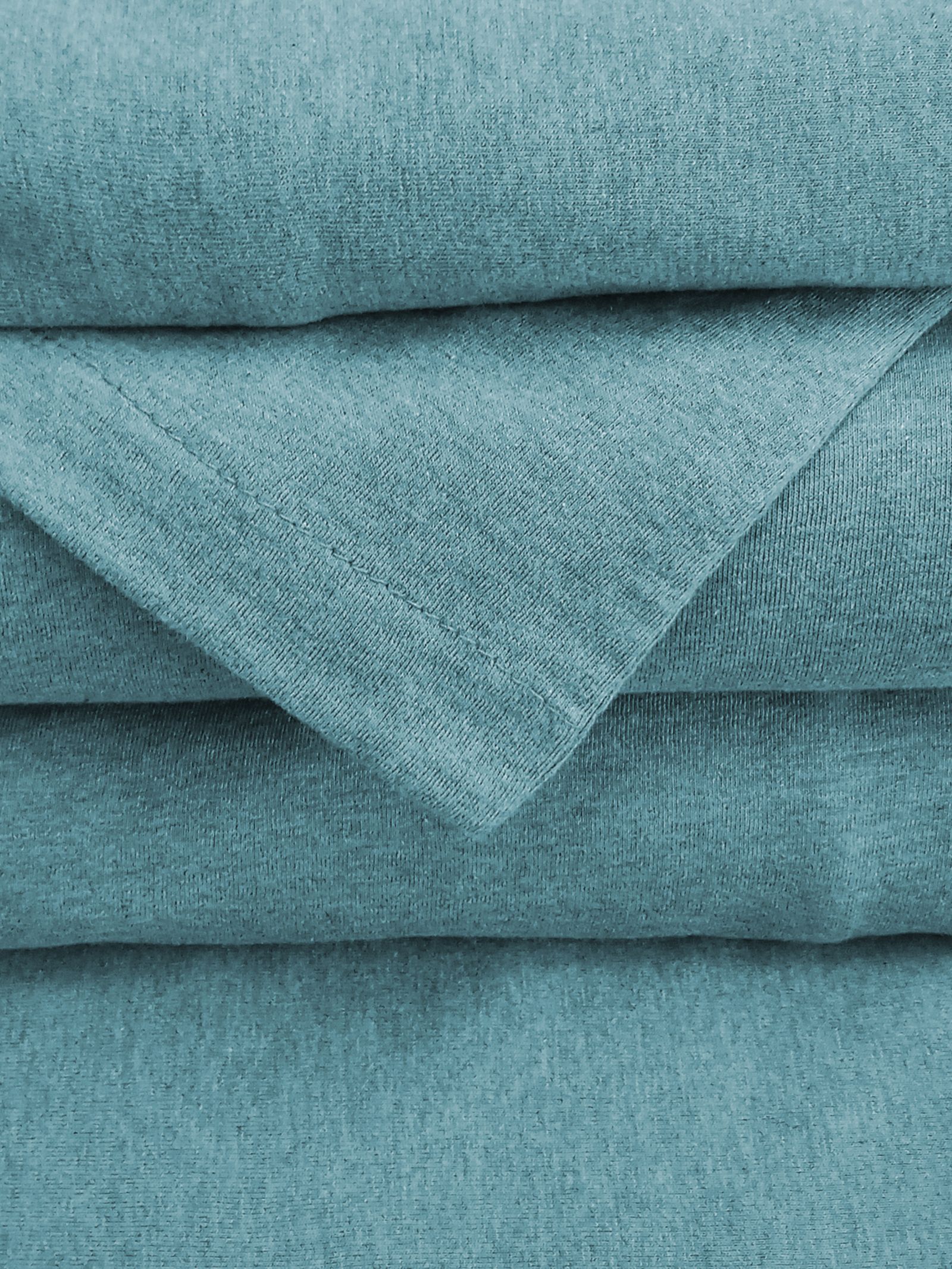
GSM stands for grams per square metre: the weight of one square metre of fabric. It is a density number, not a count. A higher GSM means more fibre packed into the same area, and for flannel that is the whole story — warmth, weight, drape and durability all move with it. Flannel gets its cosy feel from brushing: fine wire brushes raise the surface fibres into a soft, fuzzy nap that traps warm air against your skin. That brushing is also exactly why thread count stops meaning anything. Thread count counts the threads woven into a square inch of flat fabric; once the surface has been brushed into a nap, the threads underneath are no longer what your skin meets, and no longer what keeps you warm.
Every serious flannel guide says the same thing. Saatva’s guide puts it plainly: flannel quality is judged by weight, not thread count, and 170 GSM or higher is high-quality flannel that will be quite warm. Puffy’s guide gives 170–200 GSM as the good range. Orezon’s 2026 guide calls 170 GSM (5 oz) the standard for good flannel and 190 GSM and up genuinely heavyweight. Linen Society sets the baseline at 160–170 GSM and calls 190–200 GSM a substantial winter weight. The numbers agree with each other — and that agreement is the reason this guide can give you a scale instead of a shrug.
How do brands measure and report GSM? Inconsistently, and that is part of the problem this guide solves. Reputable makers weigh a cut square of the finished, brushed fabric and print the result — GSM or ounces per square yard — in the specifications. One ounce per square yard is about 34 GSM, so 5 oz is about 170 GSM and 6 oz is about 203 GSM. But many listings report nothing at all, or report the weight of the unbrushed base cloth, which reads lower than the finished sheet you actually sleep under. There is no independent body that audits a brand’s GSM claim, so the number is a claim, not a certification. That is why the checklist near the end of this guide matters as much as the table.
Two more things GSM does not tell you. It does not tell you the fibre — 170 GSM of short-staple cotton and 170 GSM of long-staple cotton weigh the same and wear very differently. And it does not tell you how the fabric was brushed — a double-brushed 170 GSM sheet (brushed on both faces) feels warmer and softer than a single-brushed one at the same weight, because there is more nap trapping air. GSM is the first filter, not the only one.
The master table: flannel GSM by sleeper and room
Bookmark this table. It is the whole guide in one place; the sections below it explain the edges and the exceptions.
| Band | GSM range | Warmth & feel | Best for | Trade-offs |
|---|---|---|---|---|
| Light | ~120–150 GSM (~3.5–4.5 oz) | Light, breathable, thin nap; feels like a soft sheet, not a winter sheet | Hot sleepers; warm bedrooms (68°F / 20°C and up); shoulder seasons | Least warm; thinnest nap; budget sets pill early |
| Mid | 150–170 GSM (~4.5–5 oz) | Cosy everyday warmth; drapes like a sheet | Most sleepers in a cool bedroom (60–68°F / 16–20°C); all-winter use in a heated home | Not enough for a cold sleeper in an unheated room; short-staple mid-weight pills |
| Heavy | 170–200 GSM (~5–6 oz) | Proper winter warmth; dense nap, noticeably heavier | Cold sleepers; cold bedrooms (below 60°F / 16°C); deep winter | Slower to dry; too warm for hot sleepers; heavier nap pills more unless long-staple |
| Ultra | 200+ GSM (~6 oz and up) | Blanket-heavy; very warm, very substantial, slow to dry | Very cold rooms only | Too warm for most sleepers; can feel clammy; longest drying time |
The bands are drawn from the published guidance, not invented: under ~150 GSM reads as thin and fast-wearing (Orezon, Linen Society, LA Mattress), 160–170 GSM is the realistic entry point for flannel that survives a few winters (Linen Society, LA Mattress), 170 GSM is the good-quality line every major guide names (Saatva, Puffy, Amerisleep, Orezon), and 190–200 GSM is where the guides agree the weight becomes substantial winter gear (Linen Society, Orezon, Amerisleep).
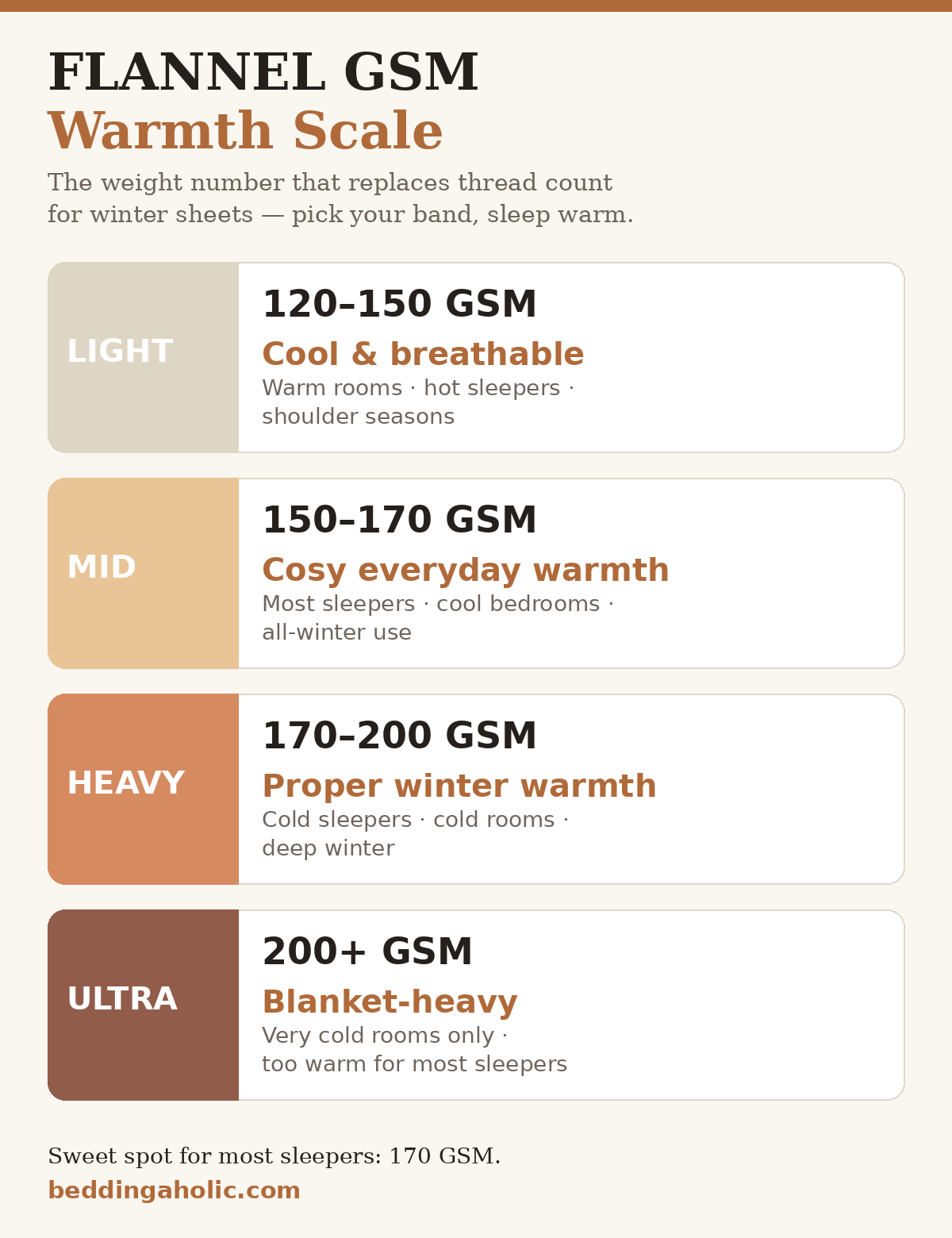
A note on the room temperatures: they are this guide’s own practical bands, built from the guides’ advice about warm and cold sleepers, not from a laboratory study. Bedrooms vary — a 62°F room with a heavy duvet feels different from a 62°F room with a light one — so treat the temperatures as starting points and your own sleep as the final judge. The picker uses the same bands, so the two can never disagree.
The GSM picker: your room + your sleep type
Two questions decide your band: how cold is your bedroom at night, and do you run hot, average or cold? Answer them below and the picker gives you a band. If the picker does not run on your device, the table underneath it gives the exact same answers.
Find your flannel GSM
Your band: Mid — 150–170 GSM. Cosy everyday warmth for most sleepers in a cool bedroom.
If the picker above does not load, use this table — it gives the exact same answers:
| Bedroom at night | Hot sleeper | Average sleeper | Cold sleeper |
|---|---|---|---|
| Warm — 68°F / 20°C or higher | Light · 120–150 GSM | Light · 120–150 GSM | Mid · 150–170 GSM |
| Cool — 60–68°F / 16–20°C | Light · 120–150 GSM | Mid · 150–170 GSM | Heavy · 170–200 GSM |
| Cold — below 60°F / 16°C | Mid · 150–170 GSM | Heavy · 170–200 GSM | Heavy · 170–200 GSM |
Two things the picker cannot know. First, your duvet matters as much as your sheets: a heavy duvet over light flannel can be warmer than heavy flannel under a light duvet. If your room is cold and you already own a good winter duvet, start one band lighter than the picker says. Our Scandinavian two-duvet guide shows how couples split the warmth instead of fighting over one weight. Second, guests are a different case: a guest room is usually colder than the room you sleep in, and your guest cannot tell you they are cold at 3 a.m. — for a guest bed, go one band heavier than the picker says for yourself, and our holiday guest-bedding checklist covers the rest of the guest bed.
The warmth threshold: where a sheet becomes a blanket
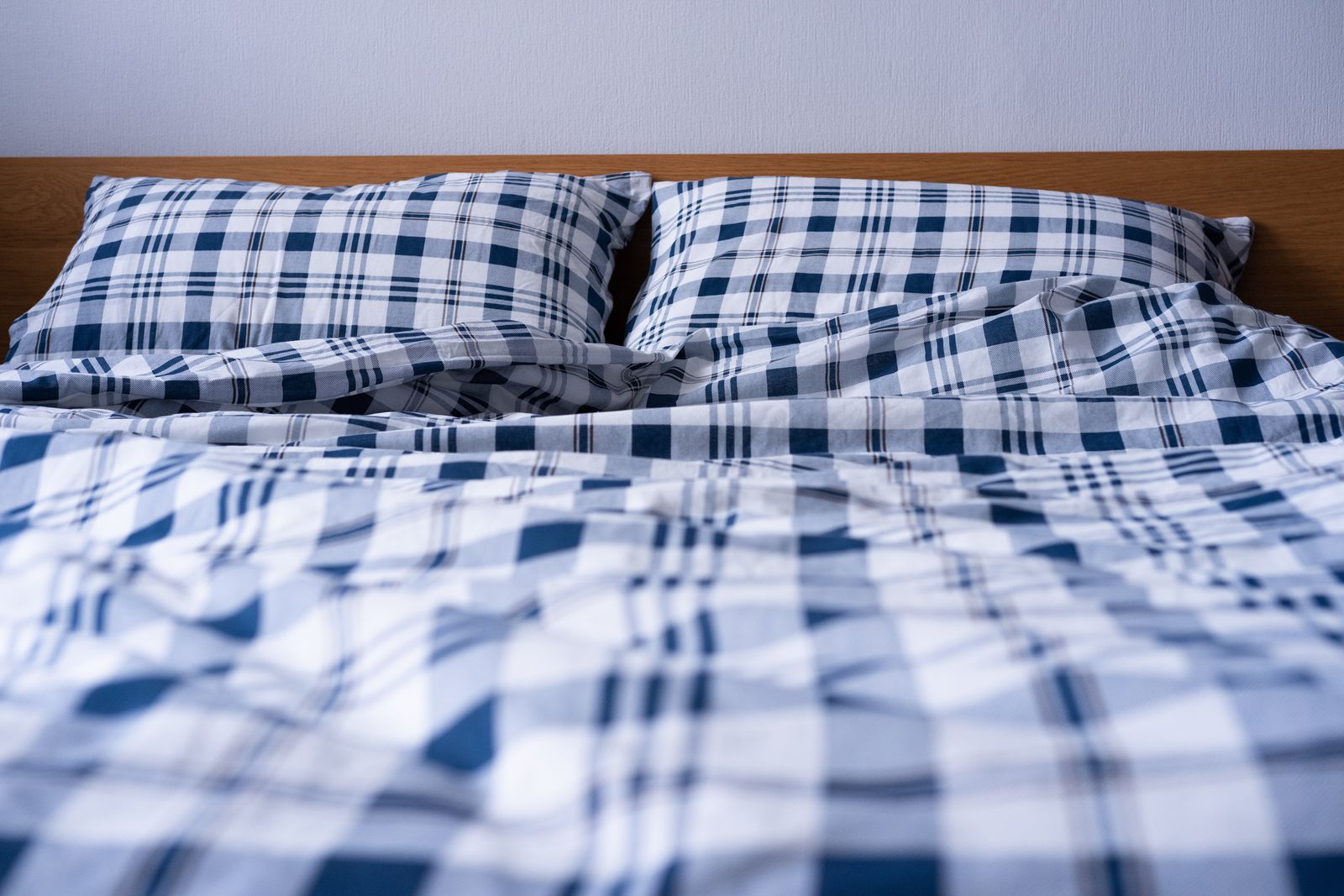
Somewhere around 200 GSM, flannel changes character. Below it, the fabric still drapes, folds and breathes like a sheet. Above it, it hangs heavy, dries slowly, and starts to feel like sleeping under a light blanket rather than between sheets. That is the warmth threshold, and it is the most useful line in this whole guide — because the guides agree on it from both directions. Orezon calls 190 GSM and up heavyweight and warns it is slower to dry; Linen Society calls 190–200 GSM a substantial winter weight and adds that a 200 GSM sheet in a steadily heated bedroom will be too much for a warm sleeper; LA Mattress’s flannel guide says the same thing in plainer words — 190 GSM and up is genuinely warm, genuinely durable, and genuinely too hot for a lot of people.
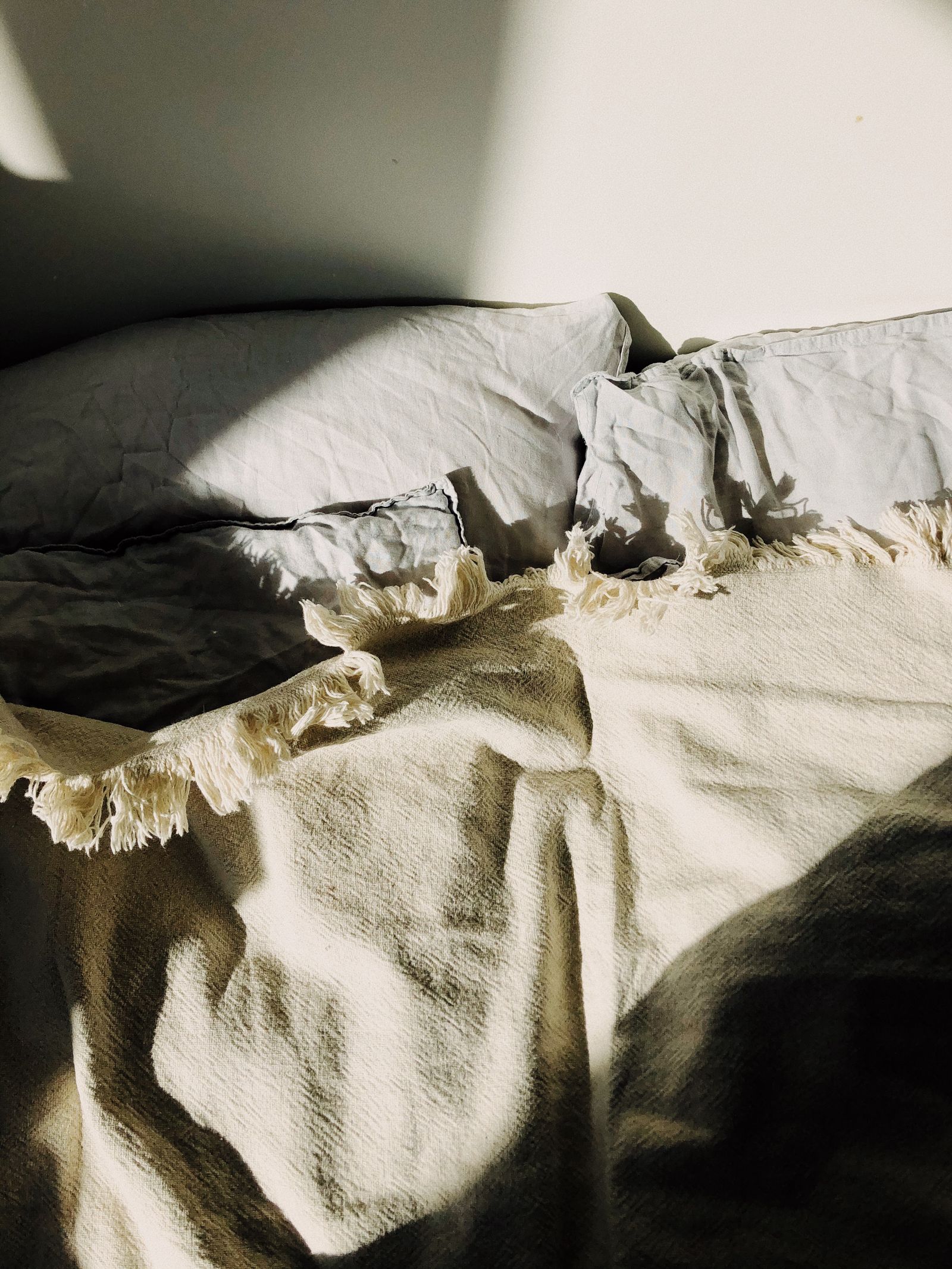
Heavier does not keep helping. Warmth from flannel comes from the nap trapping still air; once the nap is dense enough to trap the air around your body, adding more fibre adds weight and drying time faster than it adds warmth — and it starts trapping moisture too. Cotton absorbs sweat and dries slowly, so a very heavy cotton flannel can feel clammy by morning. If 170–200 GSM still leaves you cold, the answer is almost never 220 GSM. It is a warmer duvet, a second layer, or heat where you actually need it: our best heated blankets guide covers the safety-first choice, and the heated mattress pad vs heated blanket comparison settles which one warms the sleeper rather than the room.
The threshold also runs the other way. Below about 120 GSM, flannel is barely flannel at all — the nap is too thin to trap much air, and the fabric wears through quickly. The guides are blunt about this end too: below roughly 150 GSM you are usually looking at something that will feel thin and wear out quickly (Linen Society), and Orezon’s guide puts budget sets under ~150 GSM in the same bracket — light, thinner nap, least cosy, and the fastest to pill. If a listing will not state a GSM at all, assume the worst — the next section explains why.
The pilling trade-off, stated plainly
Here is the deal flannel makes with you: the same brushing that makes it warm makes it pill. Brushing raises fibre ends to the surface on purpose. Those raised ends are what trap air and feel soft — and they are also the loose ends that friction rolls into little balls. Every flannel sheet pills more than a flat-weave cotton sheet. The question is never whether it pills, but how fast and how badly.
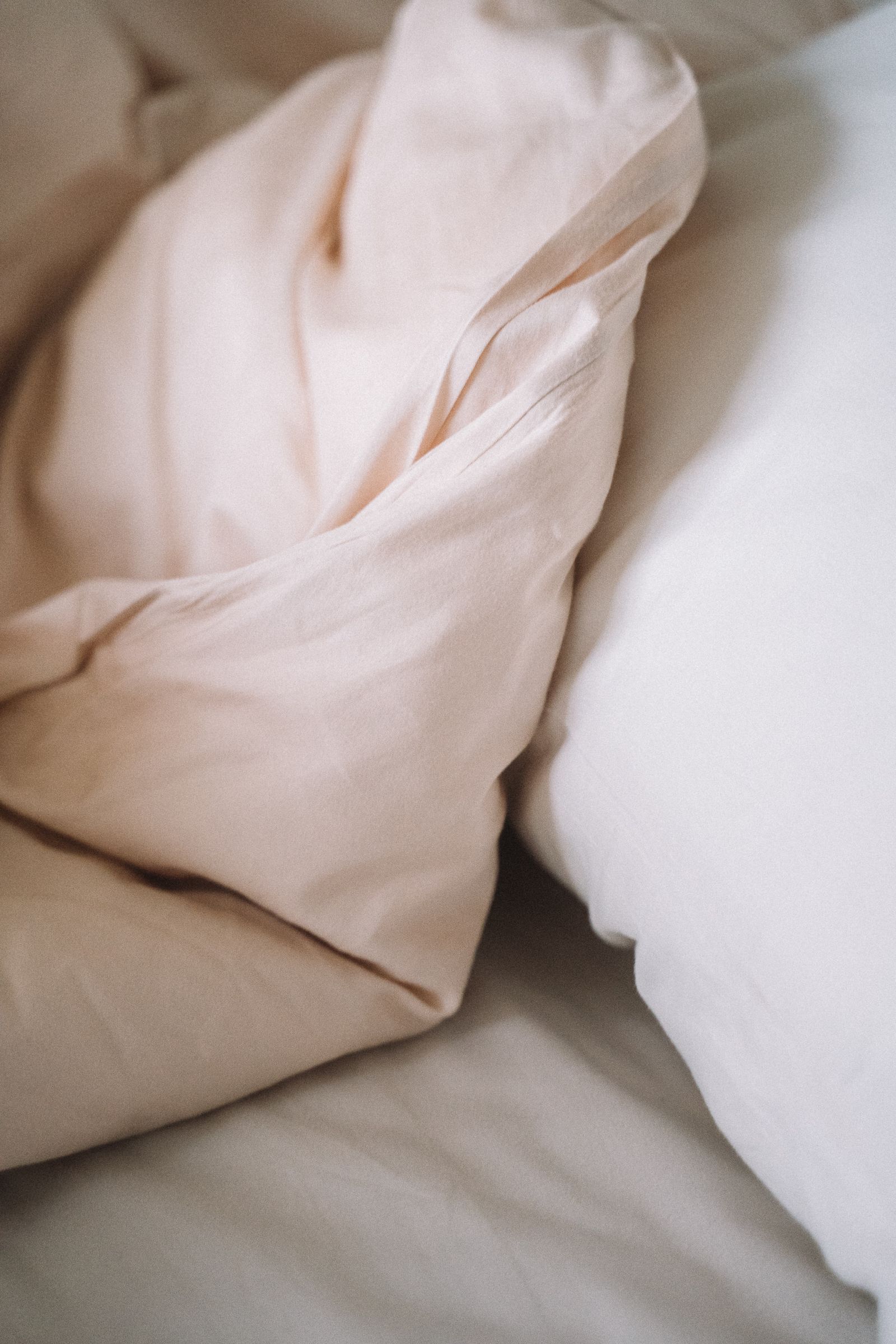
Three things decide the speed. First, fibre length. Short-staple cotton has more fibre ends per inch of yarn, and every end is a future pill; long-staple cotton (Pima, Supima, Egyptian) spins into a finer, more even yarn with far fewer exposed ends, so it pills least. Mattress Clarity’s pilling guide says it directly — longer, single-ply fibres such as Egyptian cotton are less likely to break down — and Brooklinen’s guide makes the same point: pilling is fundamentally a cotton-quality problem, not a washing problem. Second, weight. A heavier, more heavily brushed nap has more raised fibre to pill, so a 200 GSM sheet will usually pill faster than a 150 GSM sheet made from the same cotton. Third, blend. Cotton-polyester blends pill worst of all, because the polyester fibres are stronger than cotton: the cotton breaks and the polyester holds each pill in place, so pills that would have shed off a pure-cotton sheet stay stuck (Circadian Rest’s pilling guide, citing a 2020 study in the Journal of Engineered Fibers and Fabrics).
What to look for, then: 100% cotton, long-staple named on the listing (Pima, Supima or Egyptian — not just “premium cotton”), double-brushed rather than single-brushed, and 170 GSM rather than 200+ if pilling bothers you. What not to do: buy a cotton-poly blend because it is cheaper and “wrinkle-free” — you are buying the pills with it. L.L.Bean’s current Ultrasoft Comfort Flannel — 5 oz, about 170 GSM, woven in Portugal — is sold on a process developed with its Portuguese mill specifically to remove surface fibres and make the sheets more pill-resistant. That a heritage brand spent two years and 75 testers on pill resistance tells you how real the problem is. A fabric shaver takes pills off; only the fibre choice stops them coming back.
GSM vs thread count: why the two numbers cannot be converted
People ask for a GSM-to-thread-count conversion because every other sheet they own was sold by thread count. There is no conversion, and anyone selling you one is guessing. Thread count counts threads per square inch of woven cloth. GSM weighs a square metre of finished fabric. They measure different things in different units, and for flannel the thread count is measured before the step — brushing — that decides how the sheet actually feels. A flannel set can honestly carry a thread count of 150–180 and be excellent, a number that would be a red flag on a percale sheet. LA Mattress’s flannel guide makes exactly this point: plenty of excellent flannel sits in the 150–180 thread-count range, which would be a red flag in percale.
What to check instead: the GSM (or ounces), the fibre and staple length, and whether it is brushed on one side or both. If a flannel listing leads with a big thread count — 800, 1,000, more — and hides the GSM, it is selling you the wrong number on purpose: a high thread count on flannel is not a sign of quality, it is a sign the seller hopes you will not ask about weight.
Cotton flannel vs microfiber flannel
Not everything sold as “flannel” is cotton flannel. Microfiber flannel — usually brushed polyester, sometimes called microflannel — is a different fabric wearing the same word, and its GSM numbers live on a different scale. That is the trap: a 110 GSM microfiber sheet and a 170 GSM cotton flannel sheet are not 60 GSM apart in warmth. They are different materials, and the numbers do not compare.
| Cotton flannel | Microfiber flannel | |
|---|---|---|
| Fibre | Cotton, brushed | Polyester (sometimes with nylon), brushed |
| Typical GSM | 150–200+ GSM (good: 170+) | 90–120 GSM |
| Feel | Warm the moment you get in; soft, slightly weighty drape | Very soft and smooth at first touch; can feel cool, then warm overnight |
| Breathability | Breathes better; absorbs moisture, dries slowly | Traps more heat; absorbs little, can feel clammy |
| Pilling | Pills; least with long-staple cotton | Pills and holds pills (polyester does not shed them) |
| Care | Shrinks slightly at first; softens with washing | Resists shrinking; dries fast; avoid high dryer heat |
| Price (queen set) | Roughly $50–200 | Roughly $25–70 |
The GSM ranges and the price ranges in this table come from Amerisleep’s flannel-vs-microfiber comparison and Home Gear Today’s comparison, which agree on both: cotton flannel 170–200 GSM against microfiber 90–120 GSM, and roughly $50–200 against $25–70 for a queen set. The care and feel rows are the same two guides’ consensus: cotton breathes and absorbs, microfiber traps heat and dries fast. The rule that follows is simple: compare GSM only within the same fibre. A 120 GSM microfiber sheet is a normal, substantial microfiber sheet; a 120 GSM cotton flannel sheet is a light one. If a listing says “flannel” without saying cotton or microfiber, check the fibre content line before you check anything else — that one word decides which scale you are reading.
How to check GSM on a listing — and when a missing GSM means walk away
Brands hide GSM in three places: the specifications table (sometimes under “fabric weight”), the bullet list (“170 GSM double-brushed cotton”), and the product description (“5 oz flannel”). Check all three before you conclude it is missing — some listings state ounces and never say GSM, and 5 oz is 170 GSM. If the listing states neither GSM nor ounces, treat that as information, not an oversight. A maker proud of its weight prints the weight; a maker selling thin flannel at a heavy-flannel price has every reason not to.
Red flags, in order of seriousness. First, no weight at all and a leading thread count — the seller is steering you to the wrong number. Second, a GSM that does not match the price: a “200 GSM” queen set for $25 is either not 200 GSM or not cotton; honest cotton flannel runs roughly $50–200, and a number far below that should make you check the fibre line. Third, a weight given in ounces without saying per square yard — ounces alone, without the area, means nothing. Fourth, “heavyweight” or “premium weight” with no number anywhere: adjectives are not specifications.
When a missing GSM means walk away: when the set is over about $60 and the listing gives you a thread count instead of a weight, or neither. Below that price, a missing GSM is a gamble you are choosing knowingly. Above it, you are paying heavy-flannel money for an unknown weight, and the honest move is to buy the set that prints its number. One more check costs nothing: search the brand name plus “GSM” before you buy. If no review, guide or listing anywhere states the weight, the brand has never wanted you to know it.
Care: washing and drying change how GSM feels — and how fast it pills
GSM is measured on new fabric. Washing changes it, in two ways. First, cotton flannel shrinks slightly in the first washes, which tightens the weave and can make the sheet feel a touch denser and warmer. Second, every wash breaks a few more fibre ends loose, which is why pilling gets worse with washing even as the sheet gets softer. The care routine that slows the second effect down is the same one in our full how to wash bedding master chart, so here is the flannel version in short.
- Wash cold or warm, never hot. Hot water accelerates fibre breakdown and shrinkage. Cold is kindest to the nap; warm is fine if the label allows it.
- Gentle cycle, and wash flannel with flannel. Zips, jeans and rough fabrics in the same load rub the pills into being. Wash the set together.
- Skip fabric softener. It coats the fibres and flattens the nap — the sheet feels slicker and traps less air, which is the opposite of what you bought flannel for.
- Dry low, and take it out slightly damp. High heat damages brushed cotton fastest. Heavy flannel (170–200 GSM) takes noticeably longer to dry than a light set; a second low-heat cycle beats one hot one.
- Shake it out before drying and after. It sheds the loose surface fibres in the dryer filter instead of on your bed.
- Expect some lint in the first washes. L.L.Bean says so about its own flannel: some lint in the dryer screen is normal and should drop off over time. If it does not after five or six washes, the cotton was short-staple.
For the rest of the bed — duvets, pillows, protectors, heated blankets — the temperatures and cycles differ per layer, and the full chart in our wash guide has them all in one place.
Buying checklist + how this guide was made
Run through this list before you buy. It takes two minutes and it catches every trap in this guide.
- Weight first: 170 GSM (5 oz) for most sleepers; 150–170 if you sleep hot; 170–200 if you sleep cold. Over 200 only for a very cold room.
- Fibre second: 100% cotton, and long-staple named — Pima, Supima or Egyptian. “Premium cotton” with no staple named is not a specification.
- Brushing third: double-brushed (both sides) over single-brushed at the same GSM.
- Blend check: no polyester in the fibre content unless you are knowingly buying microfiber — and then judge it on the 90–120 GSM microfiber scale, not the cotton one.
- Pocket depth: check it against your mattress height before you buy — flannel is thicker than percale, and a tight pocket pops corners off the bed.
- Weight stated: GSM or ounces printed on the listing. Missing weight on a set over about $60 means walk away.
- Wash rules you can live with: cold or warm wash, low dry. If the label demands dry-cleaning, it is not a sheet you will enjoy owning.
- Returns: a sleep trial or free returns, so a band that turns out too warm or too heavy can go back.
And a styling note for the cold months: flannel’s plaid and solid winter colours are the easiest seasonal switch a bed has — our Christmas bedding ideas show how the same heavy flannel set carries a festive bed without buying a whole new one.
How this guide was made
This is a research round-up, not a hands-on test. We did not sleep in, wash or wear-test any sheet for this guide. Every GSM figure in it comes from a published source named in the Sources list below — Saatva, Puffy, Orezon, Linen Society, Amerisleep, Talk About Sleep, LA Mattress, Brooklinen, Mattress Clarity, L.L.Bean’s own listing and Home Gear Today — and where those sources disagree slightly (for example, whether the good-quality line sits at 160 or 170 GSM), the guide says so. The room-temperature bands in the master table and the picker are Beddingaholic’s own practical framework, built from the guides’ advice about warm and cold sleepers; they are labelled as such and are not presented as laboratory findings. No number in this guide was invented, no product was ranked, and no price was quoted as a deal — this is a reference guide, and it will not go stale when a sale ends.
Frequently asked questions
What GSM is good for flannel sheets?
170 GSM is good for flannel sheets for most sleepers. At 170 GSM (about 5 oz per square yard) cotton flannel is genuinely warm, durable through winters of washing, and still breathable in a cool bedroom. Go lighter at 150–170 GSM if you sleep hot, and heavier at 170–200 GSM if you sleep cold or your room drops below about 60°F (16°C).
Is 170 GSM good for flannel sheets?
Yes. 170 GSM is the good-quality line named by every major flannel guide — Saatva, Puffy, Amerisleep and Orezon all put 170 GSM or higher in the high-quality, genuinely warm bracket. L.L.Bean’s bestselling Ultrasoft Comfort Flannel is 5 oz, about 170 GSM, and Saatva’s own set is 180 GSM.
What GSM is too heavy for flannel sheets?
Above about 200 GSM is too heavy for most sleepers. Past 200 GSM flannel stops feeling like a sheet and starts feeling like a blanket: it drapes heavily, dries slowly, and can feel clammy as it traps moisture. It suits only very cold rooms.
Is higher GSM always warmer?
Mostly, but not entirely. Within the same cotton flannel, a higher GSM means a denser nap and more trapped air, so it is warmer. But brushing, fibre length and your duvet matter too: a double-brushed 170 GSM sheet can feel warmer than a single-brushed 190 GSM one. GSM is the first filter, not the whole answer.
What is a good GSM for flannel sheets for hot sleepers?
For hot sleepers, 120–150 GSM is the right band. Light flannel still feels soft and brushed, but it breathes enough to let heat out. A hot sleeper in a cool room can stretch to 150–160 GSM, but 170 GSM and up will usually be too warm overnight.
Do flannel sheets pill more at higher GSM?
Yes, usually. A heavier, more heavily brushed nap has more raised fibre ends, and those loose ends are what friction rolls into pills. The fibre matters more than the weight, though: long-staple cotton (Pima, Supima, Egyptian) pills far less than short-staple cotton at the same GSM, and cotton-polyester blends pill worst of all because the polyester holds each pill in place.
Is thread count or GSM more important for flannel?
GSM is more important for flannel. Thread count counts threads in flat woven cloth, but flannel’s warmth comes from the brushed nap, which thread count does not measure. Good flannel often carries a thread count of only 150–180, which would be a red flag on percale. Judge flannel by GSM, fibre and staple length, and whether it is double-brushed.
What GSM are microfiber flannel sheets?
Microfiber flannel sheets are usually 90–120 GSM, and that number cannot be compared with cotton flannel’s 170 GSM. Microfiber is brushed polyester, not cotton, and its GSM lives on a different scale: 90–120 GSM is a normal, substantial microfiber sheet. Compare GSM only within the same fibre.
Sources
- Saatva — “Best Flannel Sheets: How to Choose Good Flannel Sheets” (170 GSM+ is high quality; Saatva’s own set is 180 GSM): saatva.com/blog/flannel-sheets-guide
- Puffy — “What Are Flannel Sheets?” (170–200 GSM is a good range): puffy.com/blogs/best-sleep/what-are-flannel-sheets-and-why-choose-them
- Orezon — “Flannel Sheets: The Honest Guide (2026)” (under ~150 GSM thin; ~170 GSM the sweet spot; 190 GSM+ heavy): orezon.co/blogs/bedding-materials/flannelette-sheets
- Linen Society — “Flannel Sheets: How Brushed Cotton Is Made and How to Choose a Weight” (160–170 GSM baseline; 190–200 GSM substantial winter weight): linensociety.com/blogs/news/what-makes-flannel-flannel
- LA Mattress — “What Are Flannel Sheets? Guide” (160–170 GSM entry point; 190 GSM+ heavyweight; excellent flannel at 150–180 thread count): mattressstoreslosangeles.com/blogs/bedding-guides/what-are-flannel-sheets
- Amerisleep — “Flannel vs Microfiber Sheets” (cotton flannel 170–200 GSM; microfiber 90–120 GSM; queen-set price bands): amerisleep.com/blog/flannel-vs-microfiber-sheets
- Home Gear Today — “Microfiber vs Flannel Sheets” (5 oz is about 170 GSM; microfiber 90–120 GSM): homegeartoday.com/microfiber-vs-flannel-sheets-which-is-warmer
- Talk About Sleep — “Best GSM for sheets” (flannel 160–165 GSM medium; 170+ GSM heavyweight; microfiber 90–120 GSM): talkaboutsleep.com/articles/what-is-the-best-gsm-for-sheets-2804a74f
- Mattress Clarity — “Why Are My Sheets Pilling and How Do I Get Rid of It?” (flannel’s loose weave and brushing make it prone to pilling; long-staple cotton resists): mattressclarity.com/bedding/sheets/how-to-get-rid-of-pilling
- Brooklinen — “Why Do My Sheets Pill?” (pilling is a fibre-length problem; long-staple cotton resists; short-staple pills): brooklinen.com/blogs/education-center/why-do-my-sheets-pill-and-how-to-make-sure-it-never-happens-again
- Circadian Rest — “Why Do Sheets Pill, and Which Sheets Pill the Least?” (ASTM D4970 pilling test; polyester holds pills in place): circadianrest.com/blogs/pillow-talk/why-do-sheets-pill-which-pill-least
- L.L.Bean — Ultrasoft Comfort Flannel Sheet listing (100% brushed cotton, 5 oz, woven in Portugal, pill-resistant process): global.llbean.com — Ultrasoft Comfort Flannel Sheet
- HomeGoodList — “Best cotton sheets for winter 2026” (1 oz per square yard is about 34 GSM; L.L.Bean is 5 oz; Coyuchi is 6 oz): homegoodlist.com/blog/best-cotton-sheets-for-winter
All source URLs returned HTTP 200 when checked on November 29, 2026. Internal links in this article: best heated blankets · holiday guest-bedding checklist · Christmas bedding ideas · how to wash bedding · Scandinavian two-duvet method · heated mattress pad vs heated blanket — all six slugs confirmed present in the live WordPress REST API post list on November 29, 2026.