How to Wash Bedding: The Master Chart for Every Layer
Last updated November 28, 2026
The quick answer
How to wash bedding, in one paragraph: wash sheets and pillowcases weekly in warm or cold water on a gentle cycle, dry on low; wash a duvet cover every two to four weeks and the duvet inside it two or three times a year; wash pillows every four to six months with a protector (monthly without one); wash a mattress protector every one to two months; wash a heated blanket only when it needs it, cold water, gentle two-minute cycle, controller detached; wash throws once or twice a month. The care label overrules everything here — if it says cold only, or dry-clean only, follow the label.
Most bedding is ruined by the same three mistakes: water hotter than the fabric can take, a cycle that agitates too hard, and drying that is too hot or stopped too soon. The chart gives you the whole bed at a glance; the sections below it explain the exceptions.
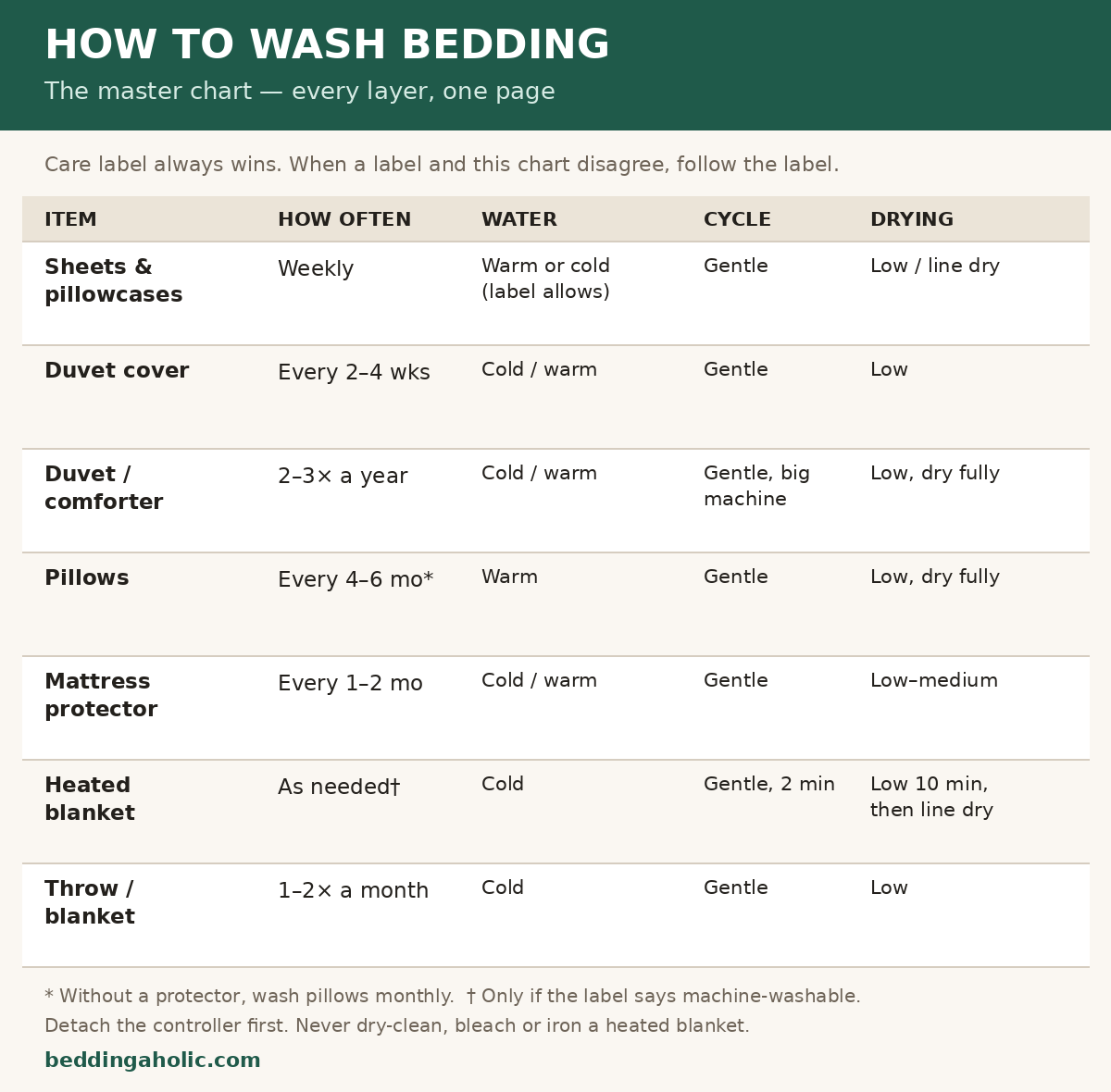
The master wash chart
Bookmark this table. It is the whole guide in one place; the sections below it explain the exceptions.
| Item | Water temperature | Cycle | Drying | How often |
|---|---|---|---|---|
| Sheets & pillowcases | Warm or cold (hottest the label allows) | Gentle | Tumble dry low, or line dry | Weekly |
| Duvet cover | Cold or warm | Gentle | Tumble dry low | Every 2–4 weeks |
| Duvet / comforter | Cold or warm | Gentle / delicate, large-capacity machine | Tumble dry low until completely dry | 2–3 times a year |
| Pillows | Warm | Gentle | Tumble dry low until completely dry | Every 4–6 months with a protector; monthly without one |
| Mattress protector | Cold or warm | Gentle | Tumble dry low to medium | Every 1–2 months |
| Heated blanket | Cold | Gentle, about 2 minutes | Tumble dry low for 10 minutes, then line dry | Only as needed, and only if the label says machine-washable |
| Throw / blanket | Cold | Gentle | Tumble dry low | Once or twice a month if used nightly |
The one rule that beats the chart
Read the care label first, every time. The chart gives the usual answer for each item; the label gives the answer for your item. Cotton sheets from one brand may take hot water while another brand’s sateen specifies cold. Bamboo and lyocell (Tencel) sheets are typically cold-wash only — many makers cap them at 30°C (86°F). Wool and silk need their own handling and are outside this chart: if the label says dry-clean only, believe it.
Where sources disagree, we give the range. The frequencies below come from the Sleep Foundation, the Asthma and Allergy Foundation of America (AAFA), The Spruce, Saatva’s care guides, and manufacturer instruction manuals — listed at the end.
How to wash sheets and pillowcases
How often: weekly, for a bed slept in every night — the figure the Sleep Foundation gives, and the AAFA and Cleveland Clinic dermatologists quoted by Healthline agree on it. Shorten it to every three to four days if someone has been ill, if you sweat heavily, or if a pet sleeps on the bed. A guest bed slept in only now and then can stretch to every two weeks, or simply be washed after each guest.
Water: warm or cold, at the hottest temperature the care label allows. The AAFA says washing bedding in water at 130°F (54°C) or hotter can reduce allergens, and a 1992 study in the Journal of Allergy and Clinical Immunology found no dust mites survived water at 55°C (131°F). But many good cotton sheets specify cold or warm, because repeated hot water wears the fibre and fades colour. The practical answer is that frequency beats temperature: a weekly cold or warm wash removes far more than a monthly hot one. Save hot water for the occasional allergy or post-illness wash, when the label allows it.
Cycle and detergent: gentle cycle, mild liquid detergent, and do not overload the drum — sheets need room to move to come out clean. Wash sheets on their own, not with heavy towels that add friction. Skip chlorine bleach: it can turn white sheets yellow and weaken the fabric. Treat stains before washing rather than hoping a hot cycle will fix them — our guide to getting red wine stains out of bed sheets covers the pre-treatment that works.
Drying: tumble dry on low, or line dry. High heat is what shrinks cotton sheets, and shrinkage often only shows up when you try to put the fitted sheet back on. Dry sheets completely before remaking the bed — slightly damp sheets on a mattress are the start of a musty bed. For bamboo or eucalyptus sheets the cold-wash rule matters more than for cotton; see our bamboo vs eucalyptus sheets comparison.
How to wash a duvet and comforter
How often: two or three times a year for a duvet or comforter that lives inside a cover (The Spruce says twice a year; Saatva’s guide quotes two to three times a year as the minimum). The Sleep Foundation and AAA’s bedding guide are stricter — both say every two to three months for a comforter — so if you sleep without a cover, or the comforter takes direct skin contact, wash it on the shorter schedule. Wash it sooner after a spill, an illness, or a pet accident. The cover takes the weekly contact — wash it every two to four weeks, or weekly if you sleep without a top sheet, since then the cover is the only barrier between skin and insert.
Machine: most down and down-alternative comforters are machine washable, but a small home washer can distort the filling. Use a large-capacity machine, or a laundromat’s commercial washers for a king-size comforter. Wash it alone, gentle or delicate cycle, cold or warm water, small amount of mild detergent. Some comforters are dry-clean only, and wool-filled ones usually are — check the label first.
Drying — the part people get wrong: tumble dry on low until the filling is completely dry, all the way through. A duvet that feels dry outside and is still damp inside will clump and can smell musty — check and keep going rather than stopping on a timer. The clumping problem has its own walkthrough in our guide on how to wash a down comforter without clumping, and fill power and blends are covered in our down feather comforters buying guide.
How to wash pillows
How often: every four to six months with a protector (three times a year on The Spruce’s figures). Without one, wash monthly, or at least every other month — the pillowcase alone does not protect the pillow as much as people assume, and oils from hair and face soak into the filling. Wash the protector itself monthly.
Which pillows can be machine washed: down, feather, cotton and synthetic-fibre pillows can usually go in the machine on a gentle cycle in warm water with a small amount of mild detergent. Wash two at a time in a top-loading machine so the drum stays balanced, and run an extra rinse. Memory foam, latex and other solid foam pillows cannot be machine washed — wet foam can tear and the core will not dry through. Spot-clean foam pillows with lightly soapy water, rinse with a damp cloth, and air dry.
Drying: tumble dry on low until completely dry, checking every 15 to 30 minutes. A pillow that goes back on the bed even slightly damp can grow mould inside the filling. If your pillows have gone yellow, that is a separate job — see our guide on how to get yellow sweat stains out of white pillows. If a pillow no longer springs back after washing, it is finished, and no wash cycle will restore it.
How to wash a mattress protector
How often: every one to two months (Sleep Foundation; The Spruce says monthly). Wash it immediately after any spill or stain rather than waiting for the calendar — that is the whole point of owning one. The mattress itself cannot be laundered, so a clean protector is what keeps the mattress clean.
Water and cycle: machine wash in cold or warm water with mild detergent, on a gentle cycle. The one thing to protect here is the waterproof coating: high heat degrades it, so keep both the wash and the dry on the cooler side — tumble dry low to medium, never high. Skip fabric softener, which can coat the waterproof layer, and skip bleach unless the label specifically allows it.
A note on fit: a protector shrunk in a hot dryer will not sit flat, and a bunched protector is worse than none. Low heat from now on. If you are setting up a guest bed, our holiday guest bedding checklist pairs the protector, sheets and pillows as a set.
How to wash a heated blanket
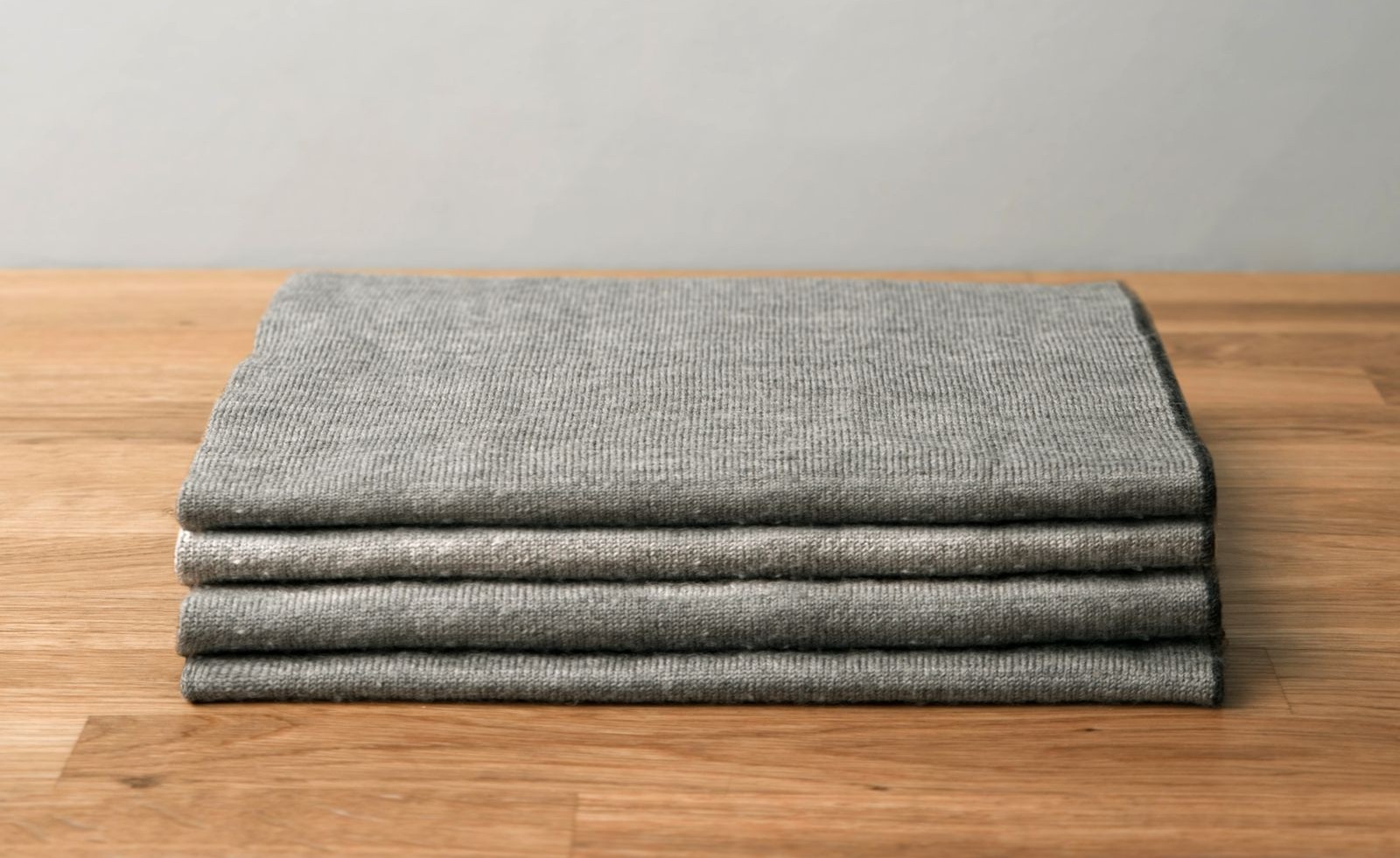
How often: only as needed — spot-clean small marks, and give it a full wash a few times a year at most. Every wash flexes the heating wires, so the blanket lasts longer when full washes are rare.
Before you start: only wash a heated blanket if its care label says it is machine-washable. If the label says otherwise, or you can see exposed wire, fraying or scorch marks, do not wash it — replace it. Unplug it from the wall first, then detach the controller and keep controller and cords out of the water. The US Consumer Product Safety Commission’s electric-blanket guidance (CPSC Publication 513) and the Electrical Safety Foundation both stress the same inspection: damaged cords and heating wire are fire risks, not cosmetic faults.
The wash, from the manufacturer manuals: Sunbeam’s instruction manual — the reference most care guides quote — says to presoak for 15 minutes in cold water with a small amount of mild detergent, wash on a gentle cycle for about two minutes, and rinse in cold water. Never use bleach, never dry-clean a heated blanket (solvents can damage the heating element’s insulation), and never use a wringer. Dry it by preheating a home dryer on low for two minutes, tumbling on low for about 10 minutes, then taking it out while still damp and draping it over a clothesline or shower rod — without clothespins — until completely dry. Never use a commercial or laundromat dryer: the heat can damage the wiring. Never iron it, and never use mothballs or sprays on it.
After drying: do not reconnect the controller or use the blanket until it is completely dry. Reconnect the cord fully — Sunbeam warns a loose connection is a fire risk — and run the blanket on its highest setting for five to seven minutes, folded, as a function check. If you are choosing one, our safety-first guide to the best heated blankets of 2026 covers auto-off, dual control and ETL/UL certification, and our heated mattress pad vs heated blanket comparison covers which suits which sleeper.
How to wash throws and blankets
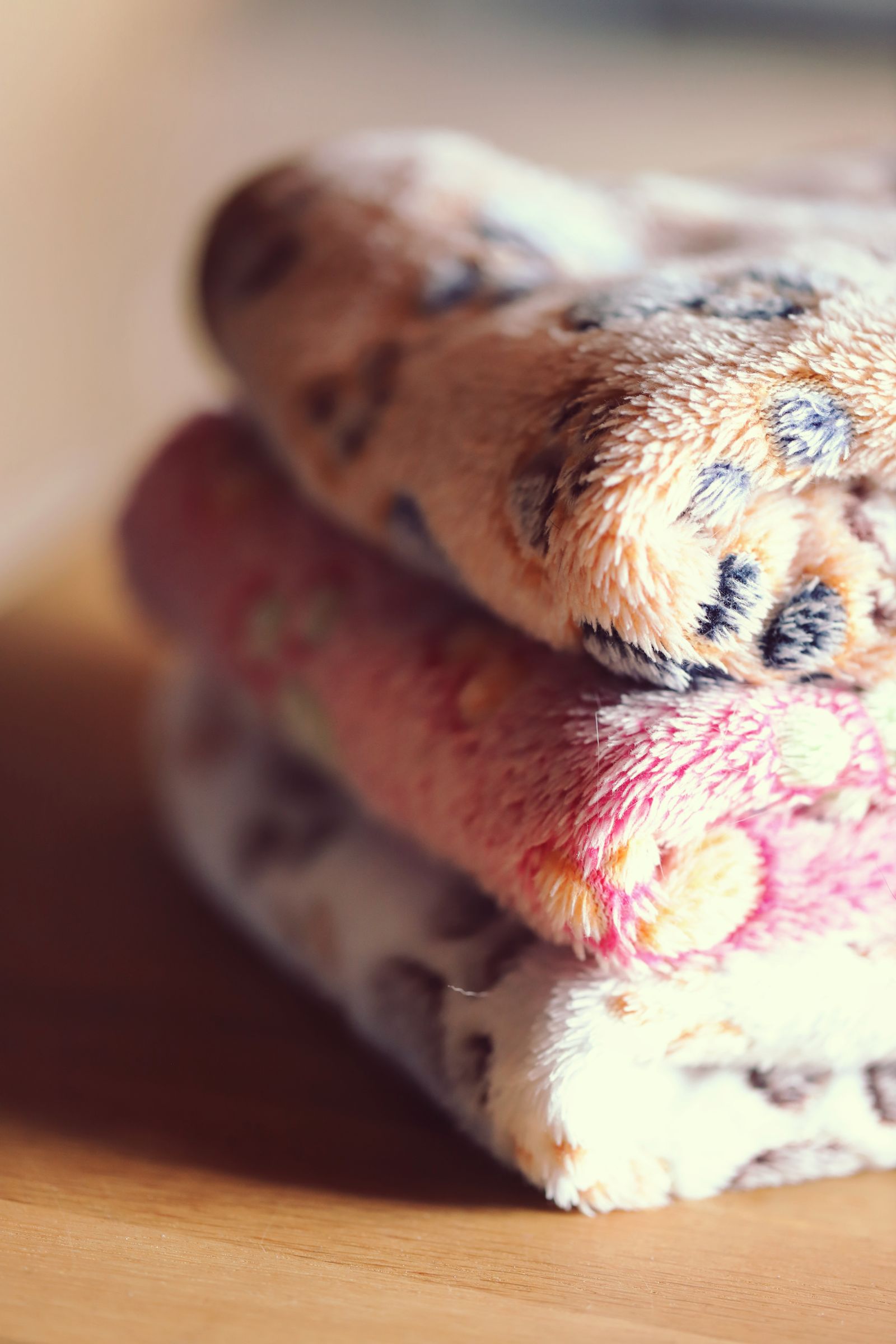
How often: once or twice a month for a blanket you actually sleep under every night; seasonally for a throw that lives folded at the foot of the bed; about once a year for a purely decorative one. The rule is the same as for everything else on this page: how often it touches skin decides how often it gets washed.
Water and cycle: cotton blankets can usually go in the machine on cold with like colours, gentle cycle, mild detergent — then tumble dry on low. Do not bleach, and avoid hot water and heavy loads. Wool, cashmere and silk blends need hand washing or the cleaner’s, according to the label. Fleece and microfibre throws are forgiving on temperature but still want a gentle cycle and low heat, which keeps them soft instead of matted.
Storage between washes: a throw folded away damp will smell musty within days. Dry it fully, and air the bed for half an hour each morning before making it.
What ruins bedding in the wash
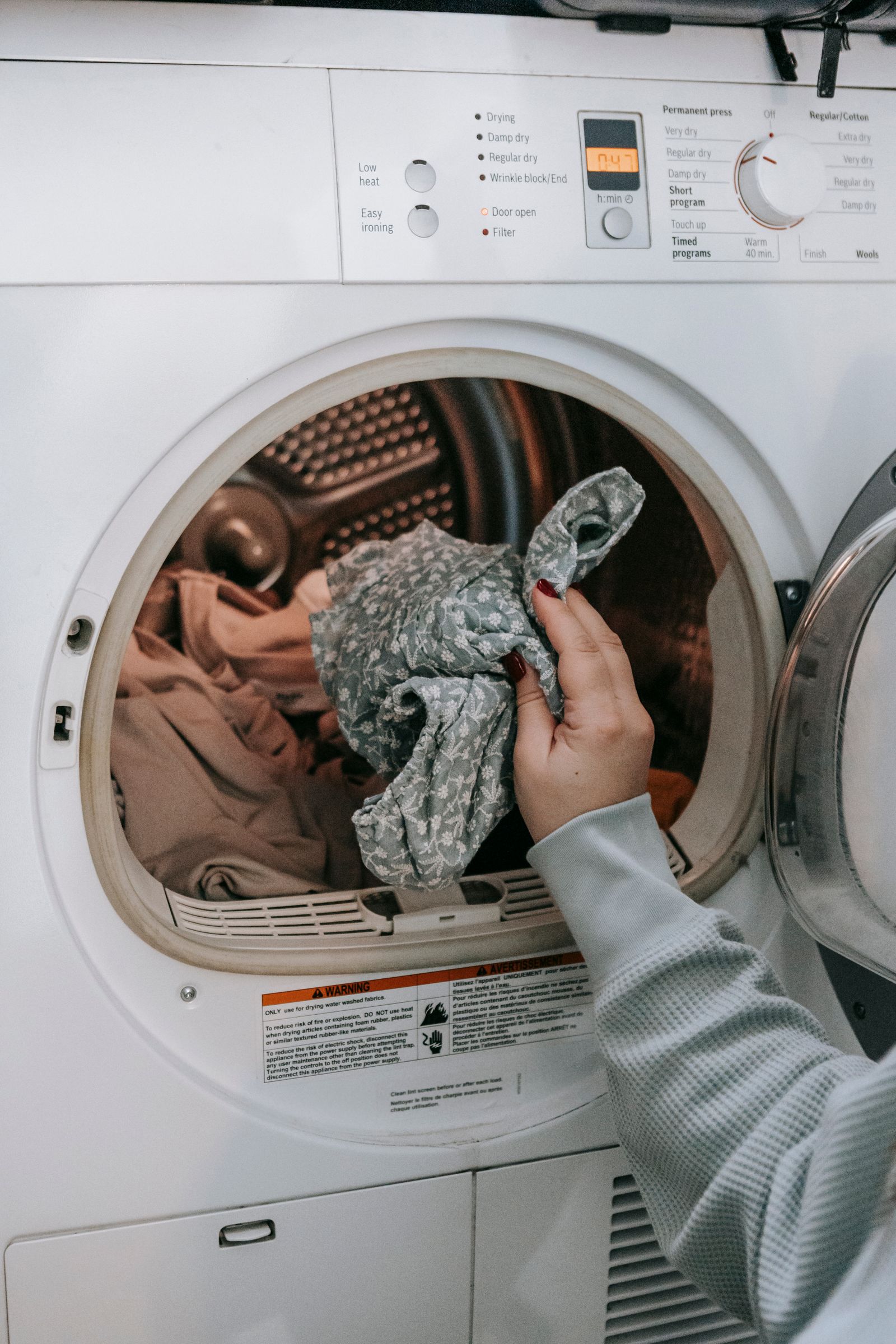
Most ruined bedding is not ruined by dirt. It is ruined by the wash itself.
Too much heat, anywhere. Hot water on a cold-wash fabric, or a high dryer setting on cotton, shrinks sheets, degrades waterproof coatings on protectors, and can damage the wiring in a heated blanket. Low heat costs a few extra minutes and saves the item.
Overloading the machine. A drum packed tight does not clean — items cannot move, detergent cannot rinse out, and the load comes out half-washed and creased. Wash sheets in their own load, wash bulky items alone, and wash pillows two at a time.
Too much detergent, and the wrong additives. Extra detergent means residue that stiffens fabric and attracts dirt. Chlorine bleach turns white sheets yellow and weakens fibres. Fabric softener coats waterproof protector layers and reduces cotton’s absorbency. A small amount of mild detergent, measured as the bottle says, is the whole recipe.
Stopping the dryer too soon. A duvet, a pillow or a thick blanket that feels dry on the outside is often still damp inside. Damp filling clumps, smells musty, and can grow mould. Dry on low until the item is dry all the way through — check the middle, not the edge — and never remake a bed with bedding that is even slightly damp.
Wringing, twisting and bunching. Never wring a heated blanket, never bunch a duvet into a small machine, and never fold a damp blanket into storage. Gentle handling in the wash is what keeps filling evenly distributed and wires intact.
Ignoring the label to follow a general tip. “Always wash bedding in hot water” is wrong for any item whose label says cold. The label is written for that exact fabric; the tip is written for bedding in general. When they disagree, the label wins.
A simple wash-day order
Strip the bed and leave the mattress bare to air while the first load runs. Wash sheets and pillowcases first, then the duvet cover, then the protector if it is due. Wash the duvet, pillows or heated blanket only on the days they are due — treating them as weekly items is how they wear out early. Dry everything on low until dry, and keep two or three sheet sets in rotation. For a guest bed, our holiday guest bedding checklist pairs with this chart; for winter, the seven-layer winter bedding system shows which layers to wash together. Couples using two duvets wash each on the same schedule as one — see our Scandinavian two-duvet size guide.
How this guide was put together
This is a research round-up, not hands-on testing. We did not wash bedding in a lab or sleep-test products for this article. Every temperature, cycle and frequency in the chart comes from published care guidance — the Sleep Foundation, the Asthma and Allergy Foundation of America, The Spruce, Saatva’s care guides, and manufacturer instruction manuals (notably Sunbeam’s heated-blanket manual) — cross-checked against at least one other source where guidance differs, and the disagreements are stated in the text. Where sources give a range, the chart prints the range. Where no reliable figure exists — such as a fixed wash frequency for heated blankets — the chart says “as needed” instead of inventing one. No product was tested, no brand was paid to appear, and no claim here rests on our own unpublished testing.
Frequently asked questions
How often should you wash your bedding?
Sheets and pillowcases weekly, for a bed slept in every night. Wash them every three to four days if someone has been ill, if you sweat heavily, or if a pet sleeps on the bed. A duvet cover needs washing every two to four weeks, a duvet or comforter two or three times a year, pillows every four to six months with a protector, and a mattress protector every one to two months.
What temperature should you wash bedding at?
Use the hottest water the care label allows, and no hotter — for most sheets that means warm or cold on a normal week. The Asthma and Allergy Foundation of America says water at 130°F (54°C) or hotter can reduce allergens, so a hot wash is worth doing occasionally for allergies or after an illness — but only when the label allows it, because repeated hot water wears cotton and can damage bamboo and lyocell, which are usually cold-wash only.
Can you wash a duvet in a washing machine?
Yes, if the label says it is machine-washable. Use a large-capacity machine or a laundromat’s commercial washer, wash the duvet alone on a gentle or delicate cycle in cold or warm water with a small amount of mild detergent, and tumble dry on low until the filling is completely dry all the way through. If the label says dry-clean only, follow the label.
How do you wash a down comforter without clumping?
Wash it alone in a large-capacity machine on a gentle cycle with a small amount of mild detergent, then dry it on low heat until it is completely dry inside as well as outside, checking and redistributing the filling as it dries. A comforter that goes back on the bed even slightly damp will clump and can smell musty. Our step-by-step guide covers the full method.
Can you wash pillows in the washing machine?
Down, feather, cotton and synthetic-fibre pillows usually can, on a gentle cycle in warm water with a small amount of mild detergent, with an extra rinse and a full low-heat dry. Wash two at a time in a top-loading machine so the drum stays balanced. Memory foam, latex and other solid foam pillows cannot be machine washed — spot-clean them instead and air dry.
Can you wash a heated blanket?
Yes, but only if the care label says it is machine-washable. Unplug it, detach the controller, and keep controller and cords out of the water. Presoak 15 minutes in cold water with mild detergent, wash on a gentle cycle for about two minutes, rinse in cold water, tumble dry on low for about 10 minutes, then line dry until completely dry. Never dry-clean, bleach or iron a heated blanket, and never use it until it is fully dry.
How do you wash a mattress protector?
Machine wash it in cold or warm water with mild detergent on a gentle cycle, every one to two months, and tumble dry on low to medium heat. Keep the heat down, because high heat degrades the waterproof coating. Skip fabric softener and bleach unless the label specifically allows them, and wash the protector immediately after any spill rather than waiting for the calendar.
Should you use fabric softener or bleach on bedding?
Usually no to both. Chlorine bleach can turn white sheets yellow and weaken the fabric, and fabric softener coats waterproof protector layers and reduces cotton’s absorbency. Use a small amount of mild detergent instead, treat stains before washing, and only use bleach or softener when the care label specifically allows it.
Sources
- Sleep Foundation — How Often Should You Wash Your Sheets? (weekly sheets; 3–4 days with pets; protector 1–2 months; pillows 4–6 months; duvet 2–3 months). sleepfoundation.org
- Asthma and Allergy Foundation of America — washing clothes and bedding in water at 130°F or more can reduce allergens. aafa.org
- Northwestern Medicine, Health Encyclopedia — wash all bedding, pillows and stuffed toys in hot water (130°F/54.4°C) every week; dry them in a hot dryer (reviewed 3/1/2024). encyclopedia.nm.org
- The Spruce — How Often to Wash Sheets, Blankets, Pillows, and More (weekly sheets; pillows 3× a year with a protector, monthly without; blankets 1–2× a month; comforters twice a year; mattress covers monthly). thespruce.com
- Saatva — How to Clean Every Type of Bedding (sheets weekly; pillows and comforters twice a year; blankets monthly or seasonally; foam pillows not machine-washable). saatva.com
- Freestone, P. (2025) — How often should you really be washing your bedding? A microbiologist explains. Phys.org, 7 July 2025 (sheets weekly at 60°C+; duvets every 3–4 months; pillows every 4–6 months).
- Sunbeam heated-blanket instruction manual, as reported in manual summaries (presoak 15 min cold; gentle cycle ~2 min; tumble dry low 10 min then line dry; never dry-clean, bleach or iron; do not reconnect until completely dry).
- US Consumer Product Safety Commission, Publication 513 — Electric Blankets (inspect for damage; damaged cords and heating wire are fire risks).
- Electrical Safety Foundation International — electric blanket safety guidance (inspect before use; follow manufacturer instructions).
- Journal of Allergy and Clinical Immunology (1992), as reported in secondary coverage — no dust mites survived water at 55°C (131°F).